Act before the bid board.
Win before the crowd.
Sympl · Signal detects early public-project signals — from initial spark through funding and scope — maps every stakeholder involved, and gives your team the context to build relationships before the posting makes it a race.
- Detect signals while projects are still forming
- Map every stakeholder — engineers, consultants, officials — with contact info
- Give commercial teams a reason to act before the crowd
Vertical-aware by design
Seven public-project categories. Each with its own signal sources and buyer patterns.
The hidden lifecycle
Public projects form long before anyone posts them.
Here's the window most teams miss.
Every public project moves through a chain of signals — from an initial spark through budgeting, scope, and finally procurement. The teams that win are the ones that see stages 1–5 instead of waiting for stage 6.
Public meeting happens
A public entity begins discussing a need, capital priority, or facilities issue through committee discussions and agenda packets.
Planning signal appears
The first real signals emerge — facilities planning, master plans, work sessions, and concept studies.
Funding starts to take shape
The project becomes real as it appears in Capital Improvement Plans, bond programs, and departmental budget spreadsheets.
Scope gets clearer
The owner clarifies the project purpose, specific location, delivery path, and likely construction timeline.
Best pursuit window opens
Designers and contractors prioritize outreach and build owner contact here — before the opportunity is public to the entire market.
Bid board posting happens
The opportunity is now visible to everyone via procurement portals. Information is reactive, crowded, and highly competitive.
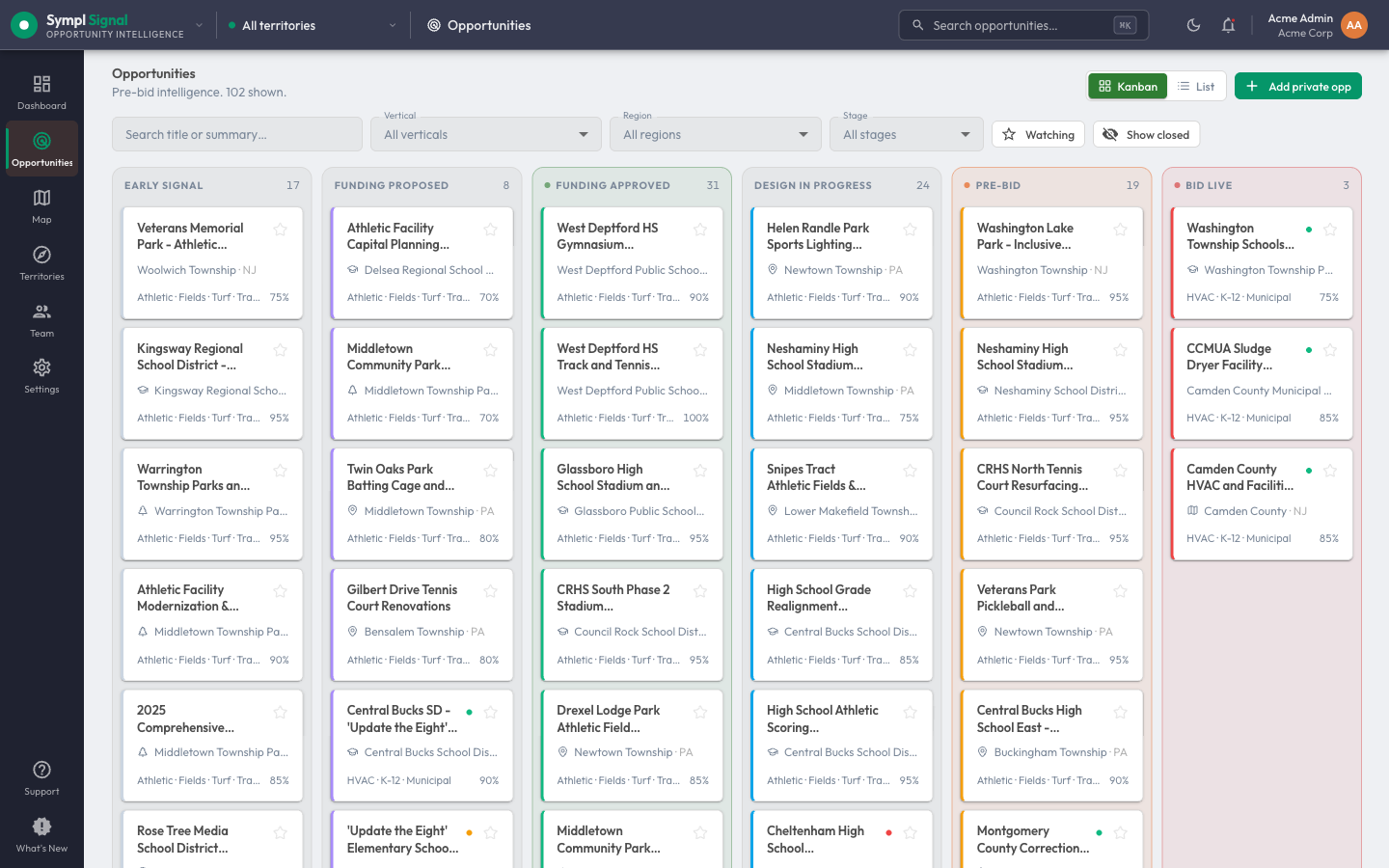
Every detected project lands on one board, staged from first signal to bid-live — so your team works a pipeline, not a stream of disconnected alerts.
The difference
Everyone sees the bid board. Not everyone sees what's behind it.
Without Sympl · Signal
Late reaction at the bid board
By the time a project reaches a bid board, everyone sees the same information. It's harder to differentiate, harder to build owner relationships, and the margins are thinner.
- Same info as every competitor
- No stakeholder relationships built
- Crowded, price-driven competition
With Sympl · Signal
Proactive pipeline from weak signals
Teams detect signals early, connect disparate public-owner activities into usable intelligence, and secure a stronger pre-bid position while the market is still catching up.
- Signals detected at stage 1–4
- Full stakeholder map with contact info & roles
- Relationship-driven pursuit, not price-driven
Platform overview
Turning weak signals into commercial intelligence.
Instead of flooding teams with disconnected updates, Sympl · Signal links disparate public-owner activities into usable intelligence — estimating project stages and highlighting why they matter now.
AI signal detection
Monitor the public-owner activity that matters — board meetings, CIPs, bond programs, and regulatory filings — and surface likely projects earlier than reactive bid tracking.
Stakeholder mapping
Surface every contact tied to a project — government officials, civil engineers, architects, consultants, design firms — with roles, contact info, and relationship context.
Evidence-backed briefs
Every surfaced opportunity comes with source context, stage rationale, and the signals behind the recommendation. Not just an alert — an actionable brief.
Territory-aware coverage
Focus by geography, owner type, and source footprint. Cover the school districts, municipalities, parks departments, and authorities in the territories you actually serve.
Commercial prioritization
Move from a pile of alerts to a tighter view of where to spend attention, outreach, and pursuit energy. Know which projects are worth pursuing now.
Pursuit window alerts
Get notified when a project advances to the next stage, when a new opportunity matches your criteria, or when the design award is announced and the spec window is open.
Real product, real data
Every brief is backed by evidence — and lives in the app.
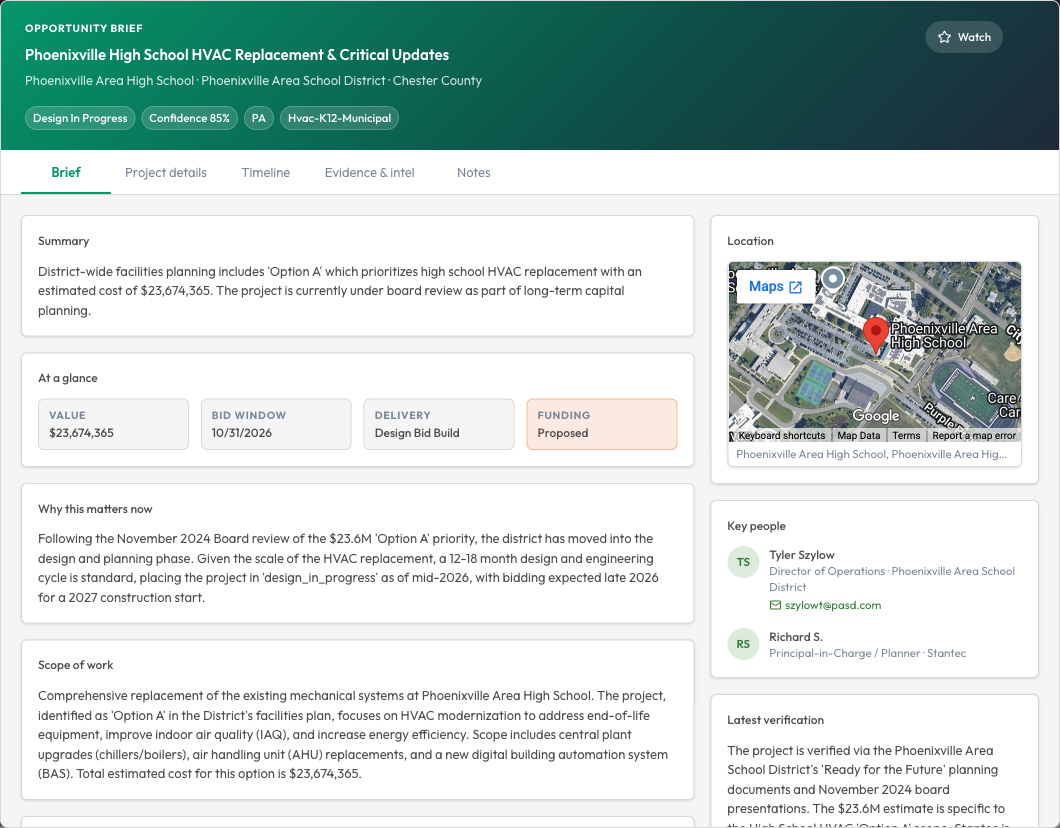
That brief isn't a summary email. It's a working record — every claim traced to a public source, staged and scored on a board your team actually works.
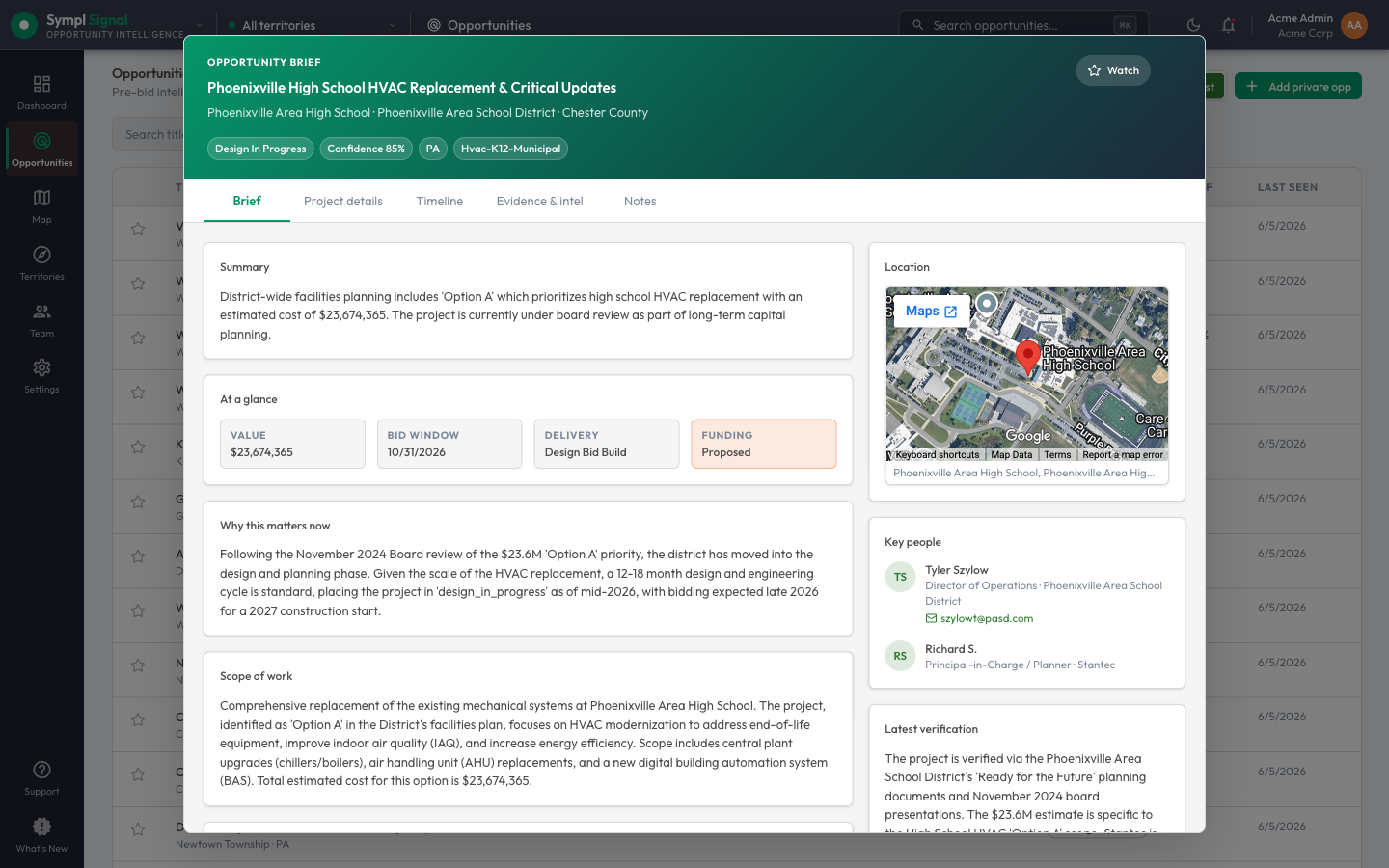
In the app, not your inbox. Briefs live on the board — staged, scored, watchable, and ready for your team to work.
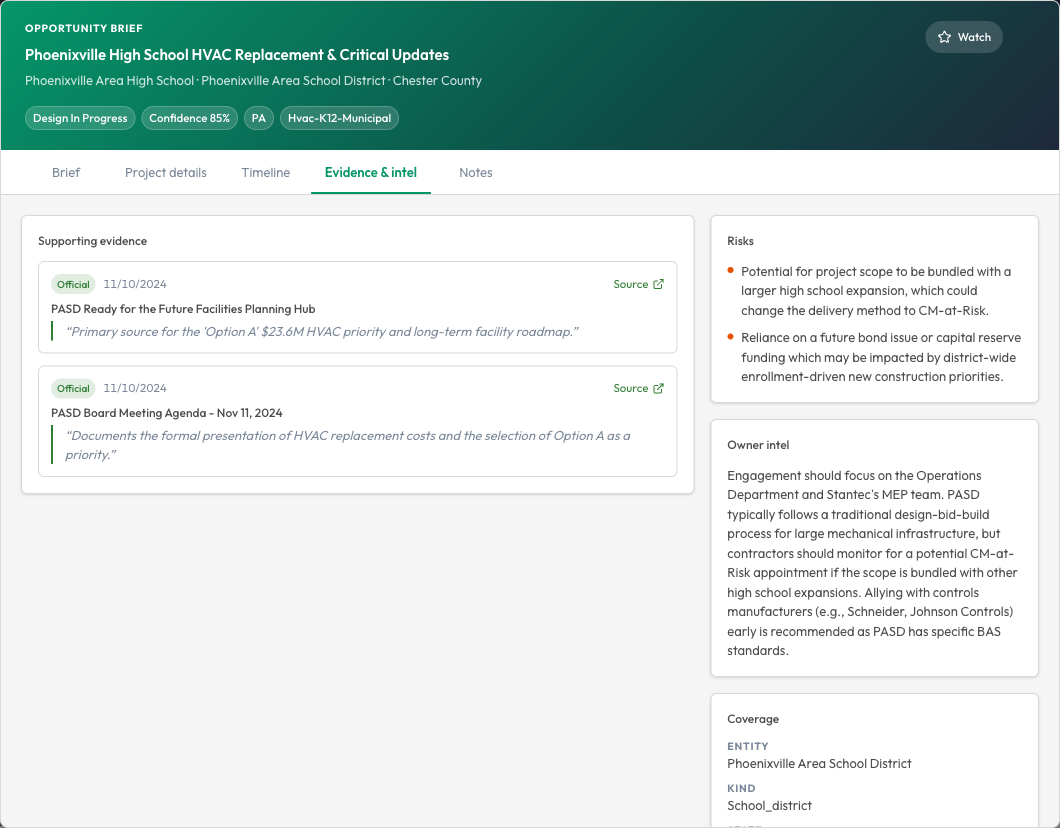
Evidence-backed. Every brief traces back to public-owner sources — board minutes, CIPs, bond language — with the quote that triggered it.
Onboarding
You pick the territories.
We handle the rest.
Tell us the regions, counties, or districts you want to cover. We handle public-entity discovery — school districts, Parks & Rec departments, municipalities, counties, authorities — and stand up your opportunity dashboard the same business day.
You define coverage
Tell us the regions, territories, and the verticals you pursue.
We handle discovery
We discover and monitor the public entities — school districts, Parks & Rec, municipalities, counties, authorities.
Dashboard goes live
Opportunities populate your dashboard — same business day.
From the blog
Winning public construction work.
Field notes on CIPs, bond programs, public meetings, funding cycles, and the pursuit strategy that separates reactive bidders from firms that build real pipeline.
Bid boards vs early-signal intelligence — what each is actually for
Bid boards and early-signal intelligence aren't competitors. They solve different problems at different stages of the public construction pursuit cycle.
How to win government construction bids without waiting for the bid board
Public projects form long before they post. Here's where to find them, what to do when you do, and why bid boards are the wrong starting point.
How to read a school district Capital Improvement Plan
A practical guide to CIPs — where to find them, what to extract, and how to turn a line item into a pursuit window 12–24 months before bid.
The public meeting intelligence playbook for construction BD
Agendas, packets, and minutes are the cheapest, richest, and most ignored pre-bid intelligence in public construction. Here's how to read them.
How school districts fund athletic field and track replacements
Bonds, capital funds, grants, and booster programs — how K-12 athletic projects actually get paid for, and how to read the funding signals.
K-12 HVAC funding after ESSER — where the money is in 2026
ESSER is winding down. Here's what's replacing it for HVAC and IAQ work — bond programs, state energy funds, DOE Renew America's Schools, and ESCOs.
FAQ
Common questions
How is this different from bid-board monitoring?
Bid-board tools light up once the market already sees the same posting. Sympl · Signal is built for the earlier lifecycle — planning, funding, and scope signals that create a better pursuit window before the crowd arrives.
Is this locked to one construction niche?
No. The platform covers seven public-sector verticals — athletic fields, parks & rec, HVAC, roofing, site work, building envelope, and public-building GC/CM work — each modeled with its own signal sources, trigger language, and buyer patterns.
What role does the AI play?
It detects weak signals, connects related evidence, infers project stage, and packages the result into something a commercial team can actually act on — not just another alert.
What kinds of sources does it monitor?
Public owner activity — board meetings, capital improvement programs, budget documents, facilities assessments, planning sessions, TDLR filings, bond ballot language, and procurement-adjacent publications.
How fast can you stand up coverage in my territory?
Tell us the regions, counties, or districts you want to cover. We handle public-entity discovery — school districts, Parks & Rec departments, municipalities, counties, authorities — and stand up your opportunity dashboard the same business day.
Stop reacting to bid boards
Start building pipeline from signals.
Sympl · Signal is designed for construction teams that need signal, timing, and prioritization before the rest of the market catches up.
it's that sympl.