Know who controls the project
before the shortlist forms.
Every public construction project has a network of decision-makers, engineers, consultants, and officials who shape its outcome. Sympl · Signal maps them — with names, roles, contact info, and project context — at the moment it still matters to know them.
Why timing matters
A stakeholder map at bid-board time is too late.
By the time a project posts on a bid board, the facilities director has already built a relationship with the design consultant. The consultant has already drafted the spec. The shortlist of preferred contractors is already formed in someone's head.
The stakeholder information that changes outcomes is useful at stage 2 or 3 — when the owner is still deciding who to trust — not at stage 6, when the field is set.
The window where stakeholder outreach works:
Stage 2–3: Planning & funding
Introduce your firm. Share case studies. Be useful before any spec is written.
Stage 4–5: Scope & pursuit
Engage the consultant directly. Align on product spec. Position for CMAR RFQ.
Stage 6: Bid board
Respond like everyone else. No differentiation left.
Who gets mapped
Every person who influences the outcome.
Sympl · Signal maps the full network tied to a project — not just the owner, but the consultants, engineers, and officials who shape what gets built and who builds it.
Facilities Director / Superintendent
School districts & municipalities
Decision-maker on scope and consultant selection. The first call that matters.
Civil Engineers & Architects
A/E firms engaged by the owner
They write the spec. Relationships here get products and firms specified in before the bid.
Program Managers & Owner's Reps
Retained for bond programs
Control contractor access across multi-year bond packages. One relationship = multiple opportunities.
Finance Directors & Business Officers
School districts & municipalities
Control cash flow timing, bond issuance schedule, and contract authority thresholds.
Consultants & Specialty Advisors
FCAs, energy audits, athletic consultants
Often the first outsider engaged. Their recommendations shape scope, delivery method, and shortlists.
Board & Council Members
Elected officials approving projects
Approval authority. Knowing who champions a project can indicate priority and timeline.
What's included
Contact info and context — not just a name and an org chart.
Each stakeholder entry includes the details your BD team needs to act, not just to recognize a name.
Full name and title
Not just an org — the person who controls the decision.
Contact information
Email, direct line, and LinkedIn profile where available.
Role in the project
Decision-maker, influencer, consultant, or oversight.
Relationship context
Which projects they're connected to, and what stage those projects are at.
Organizational relationships
Who reports to whom; which consultants work with which owners.
Engagement history
Prior projects, retained consultants, and procurement patterns.
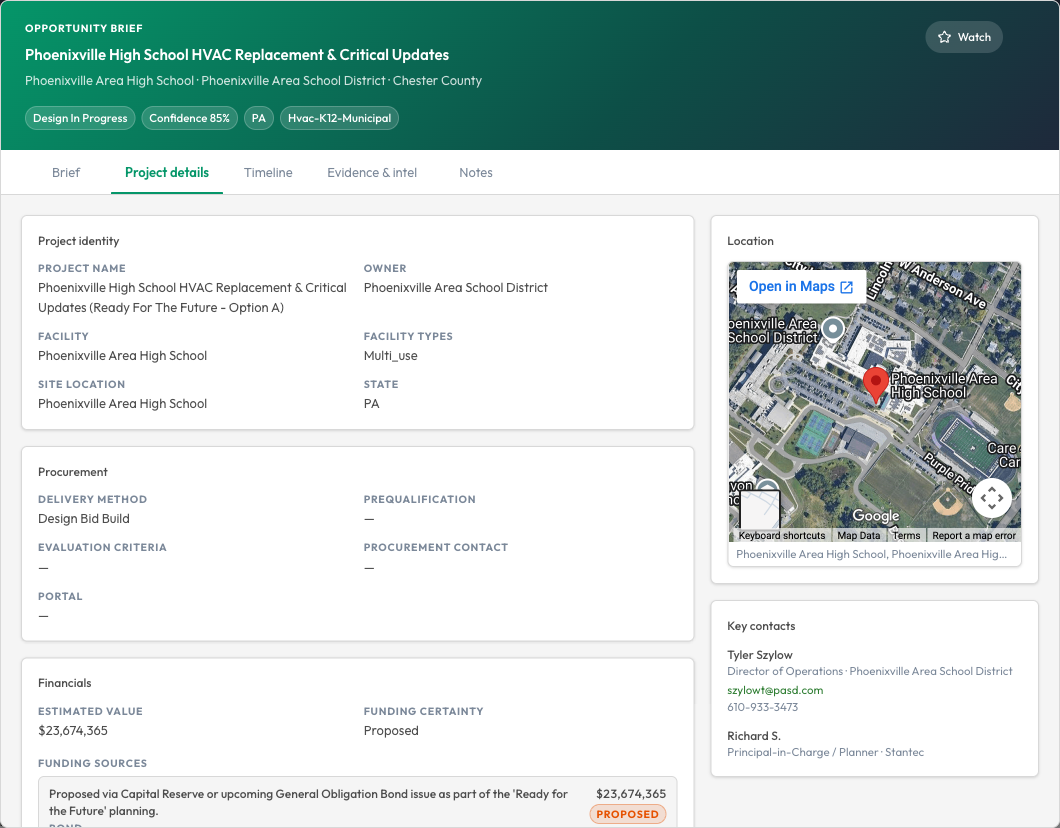
Delivery method, engaged design firm, budget, procurement contact, and the people who control the decision — captured on every project, the moment it's worth knowing them.
Know the room before you walk in.
Sympl · Signal maps every stakeholder tied to the projects in your territory — at the moment it matters.