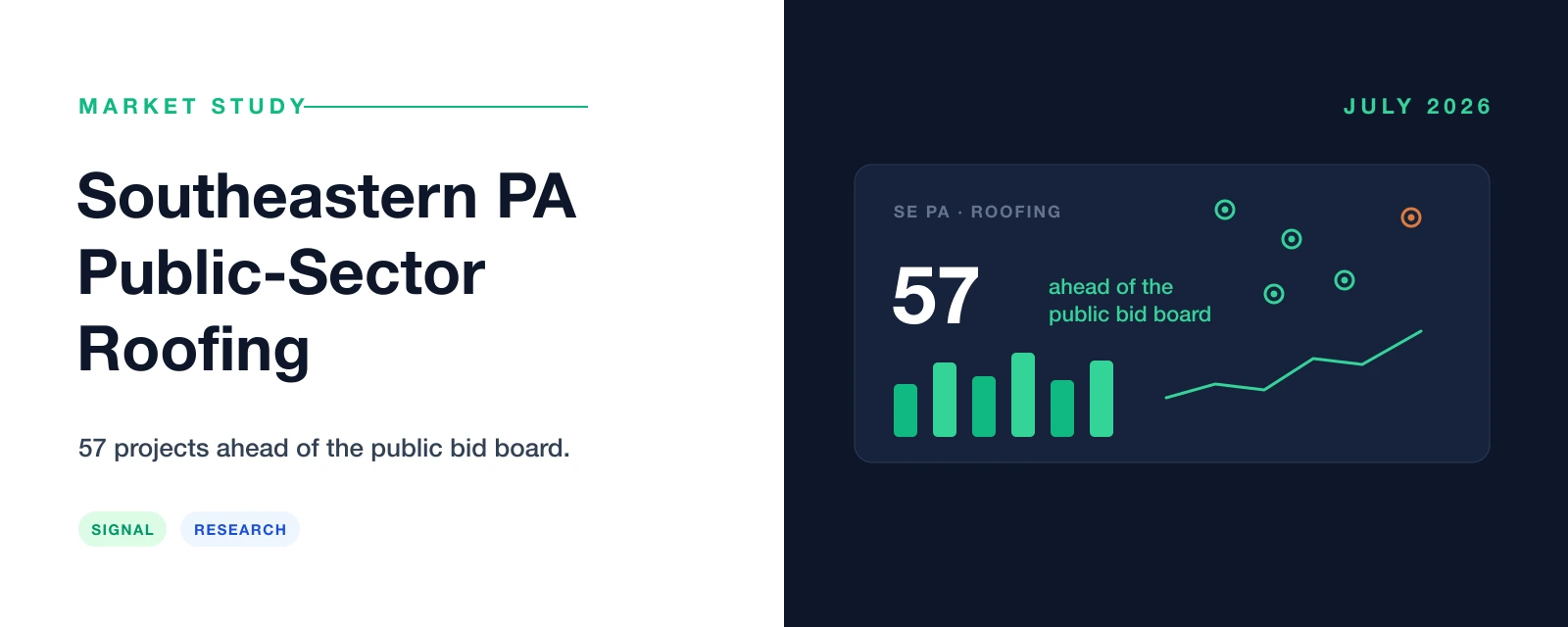
Southeastern Pennsylvania and South Jersey have 151 active public-sector roofing opportunities in SymplSignal, and 57 of them are still ahead of the public bid board: funded, proposed, or in design, before the RFP ever posts. Each of those 57 has an owner with a leaking roof, a capital line, and a program, but no published solicitation yet.
What moves a roof off the "someday" list
Public roofs get deferred until they can't be. Several forces are now pushing long-delayed roof programs into funding and design at once.
- School roof programs are carrying the pipeline. The single most common early-stage owner here is the K-12 school district, and the examples are almost all roofs: the Stone Harbor SD roof replacement on a capital bond, the Lawrence Township District-Wide Roof Replacement Program (a voter referendum, now in design), the Northfield Community Schools multi-school program (funding approved), and the Morris Goodwin and Margate / William H. Ross school roofs (both pre-bid). New Jersey districts finance this through voter bond referendums and, in the state's 31 SDA districts, through the NJ Schools Development Authority, "the State agency responsible for fully funding and managing the new construction, modernization and renovation of school facilities projects." A roof at the end of its service life is one of the clearest referendum asks a board can put in front of voters, which is why so many of these projects surface already funded.
- Pennsylvania's PlanCon reimbursement lowers the bar for major roof renovations. On the PA side, the state shares the cost of major school construction and renovation through PlanCon, "a set of forms and procedures used to apply for reimbursement." When the Commonwealth picks up part of the tab, districts move long-deferred roof work into design and bid.
- Indoor-air-quality money keeps roofs on the agenda. Roofs rarely fail alone. They show up bundled with envelope and ventilation work, where school-health funding lands. The EPA's Indoor Air Quality Tools for Schools program urges districts to "include IAQ in your renovations," and a failing roof that drives moisture, mold, and ventilation problems is a direct IAQ trigger that keeps roof-and-envelope projects funded.
- Energy performance turns a re-roof into an upgrade. A roof replacement is the cheapest moment to add a reflective "cool roof." Per ENERGY STAR, a cool roof "can lower the roof surface temperature, decreasing the amount of heat transferred into a … building," which cuts cooling costs on public buildings that run all summer and gives facilities directors a second reason to fund a roof now rather than patch it again.
The buyer landscape
Across 14 counties, SymplSignal tracks 1,539 public buyers that procure roofing work, the largest buyer base of any vertical studied in this region. School districts (294) edge out municipal governments (280) at the top, followed by cities, parks departments, county governments, and fire districts. Buyer depth is greatest in Berks, Bucks, Delaware, and Montgomery counties.
The pipeline
Of 161 tracked opportunities, 151 are active (anything not yet completed) and 57 are still ahead of the public bid board: funded, proposed, or in design, upstream of any live solicitation. Only 6 are out for bid today; behind them sits a bid-closed tail of 57 recently awarded projects, a sign of how steadily this market turns over. The mass of the early work sits in pre-bid (20) and funding-approved (16): money in hand or a solicitation imminent, the highest-intent window before an RFP. That early work is not spread evenly. Delaware (10) and Bucks (8) lead, together holding nearly a third of the ahead-of-bid pipeline, followed by a tight cluster of Chester, Montgomery, Philadelphia, and Burlington (5 each).
Roofing opportunities carry milestone dates more often than most early-stage categories, and the pattern is a steady drumbeat across 2025 and 2026 with a clear spring-2026 uptick. Lead with stage, since a funding-approved project is actionable regardless of what its posted date says.
Representative early-stage projects
A sample of the funded-but-not-yet-bid work in the pipeline:
- Stone Harbor School District: school roof replacement, capital bond (funding proposed)
- Northfield Community Schools: multi-school roof replacement program (funding approved)
- Lawrence Township School District: district-wide roof replacement program, referendum (design in progress)
These are three of 57. The full pipeline, with stage, owner, and county for every project, lives in SymplSignal.
How contractors use this
For a roofing contractor or design team, the value is the projects that aren't on the bid board yet. Prioritize Delaware and Bucks counties (nearly a third of the early pipeline), then the Chester / Montgomery / Philadelphia / Burlington cluster. Engage during funding-approved and pre-bid (the 36 projects with money or an imminent solicitation but no published RFP), and lead with the school owners, whose funding mechanism (referendum, SDA, or PlanCon) tells you how firm the money is. See how it works for public-sector roofing.
Methodology
Figures reflect SymplSignal's discovery of Southeastern PA and South Jersey public-sector roofing activity, current as of July 15, 2026, covering about 48% of the region's buyer-by-vertical cells. "Active" means any tracked project not yet completed; "ahead of the bid board" means a project is funded, proposed, or in design and has not yet posted a live bid. Buyer counts include only active public entities that procure this work; opportunity counts exclude disqualified records.
---
151 active public roofing opportunities across Southeastern PA, and 57 still ahead of the bid board, funded or in design before the RFP posts. See every one of them, with owner, stage, and county, plus the full list of 1,539 public buyers, in SymplSignal.