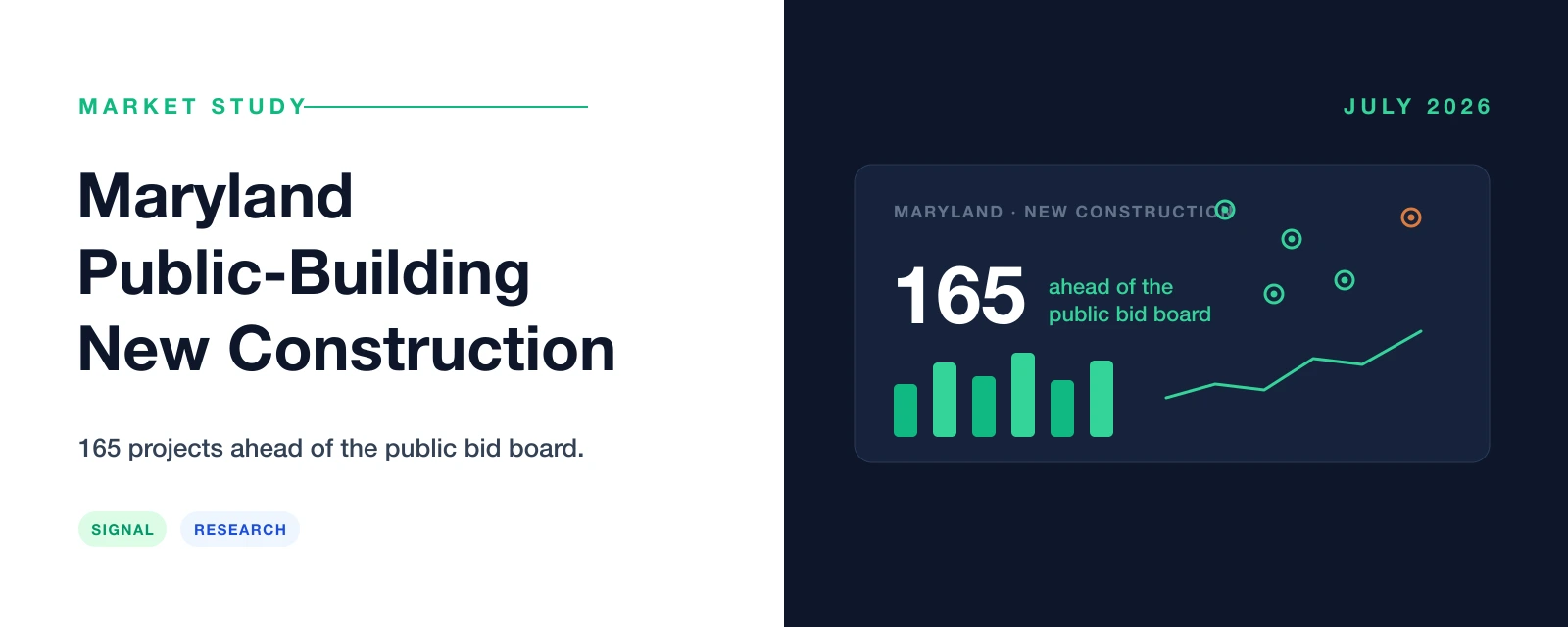
Roughly four out of five active public-building new-construction projects in Maryland are still ahead of the public bid board: 165 of the 209 SymplSignal tracks are funded or in design, before an RFP posts. Behind them sit 995 public buyers that build across all 24 counties and Baltimore City, the broadest buyer base of any Maryland construction vertical.
What's putting this much work into design
- Maryland's state capital program is at a record. The FY2026 capital budget totals roughly $5.9B, including about $1.8B in general-obligation bonds whose full-faith-and-credit debt funds new state facilities and capital grants to local governments for public buildings. Every GO-bond appropriation puts a project on the public record long before it bids.
- The Built to Learn Act is a visible, pre-RFP school-construction wave. The Maryland Stadium Authority is authorized to issue up to $2.2B in school-facility bonds, with about $1.13B issued so far and $3.6B in MOUs across 52 projects, and its next debt issuance expected in Summer 2026. Major projects clear the Interagency Commission on School Construction's site, plan, and design approvals, each a public signal months ahead of the bid.
- Prince George's County is accelerating new schools through a P3, and it tops this pipeline. The county's Blueprint Schools Program delivers new schools via a public-private partnership; Phase II adds eight new schools on a staggered four-year schedule. Prince George's holds the single largest block of pre-bid work in this dataset (24 ahead of the board).
- County and municipal governments are building civic facilities, not just schools. County governments are the single largest buyer type here (240 of 995), ahead of public works, municipal governments, parks & recreation, and fire districts. State GO bonds underwrite the local capital grants behind new town halls, senior centers, libraries, and public-safety buildings.
The buyer landscape
Across Maryland's 24 counties and Baltimore City, SymplSignal tracks 995 public buyers that commission new public buildings, the widest base of any Maryland vertical: county governments (240), public works (113), municipal governments (97), parks & recreation (92), and fire districts (90). Buyer depth is greatest in Harford (70), Prince George's (68), Baltimore County (58), Baltimore City (52), and Anne Arundel (49).
The pipeline
Of 209 active opportunities, 165 are still ahead of the public bid board, roughly four in five. The early-stage work concentrates in Prince George's County (24 ahead), then Anne Arundel (20), Worcester (16), Baltimore City (12), and Montgomery (11), together more than half of all pre-RFP work. New-project signals cluster in spring and summer 2026 and peak sharply in July, consistent with Maryland's July 1 fiscal-year start, when the enacted capital budget turns appropriations into fundable projects. Because so much of the pipeline is pre-RFP, the opportunity is in reaching owners during funding and design.
Representative early-stage projects
- State of Maryland: new Facility for Children / high-intensity residential treatment center at RICA-Baltimore (design in progress)
- Town of University Park: new town hall (design in progress)
- Worcester County: new Pocomoke library (early signal)
These are three of 165. The full pipeline, with owner, stage, and county for every project, lives in SymplSignal.
How contractors use this
Prioritize Prince George's, Anne Arundel, and Worcester counties plus Baltimore City, where the pre-RFP pipeline is thickest, and track the county-government, public-works, and municipal buyers that dominate new civic construction. With roughly four in five active projects still ahead of the bid board, the win is engaging owners and their design teams during funding and design, before a GC or CM is selected and ahead of the July budget-cycle rush. See how it works for public-building new construction.