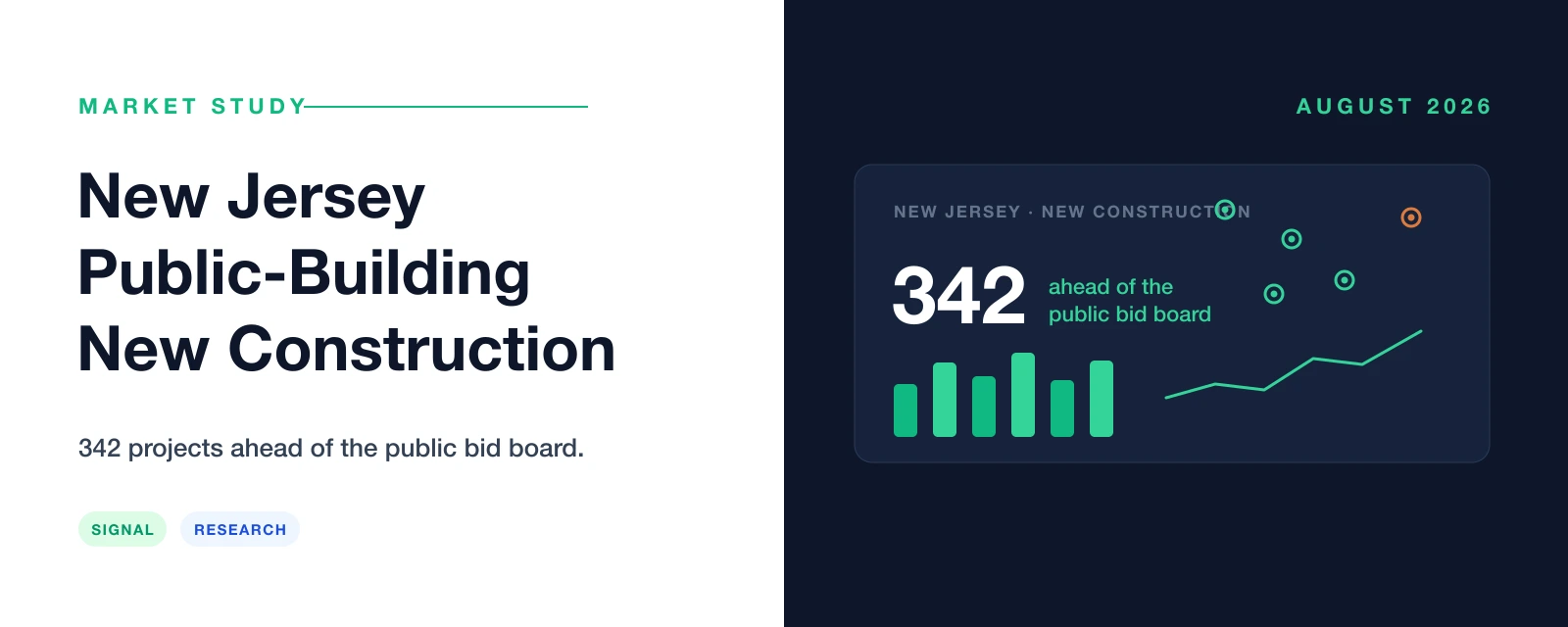
Roughly three in five active public-building new-construction projects in New Jersey are still ahead of the public bid board: 342 of the 577 SymplSignal tracks are funded, proposed, or in design, before an RFP posts. Behind them sit 1,640 public buyers that commission new public buildings across all 21 New Jersey counties: the state's school districts, municipalities, library systems, and housing authorities.
What's putting this much work into design
- In the 31 SDA districts, the state fully funds school construction. The NJ Schools Development Authority is "the State agency responsible for fully funding and managing the new construction, modernization and renovation of school facilities projects" in the SDA Districts, with a current project portfolio of roughly $2 billion. That is why school districts are the largest buyer class in this dataset (567 of 1,640).
- ROD grants co-fund building projects in every other district. For districts outside the SDA set, the Regular Operating District (ROD) grant program reimburses at least 40 percent of eligible project costs. A $350M appropriation seeded the program, and the state approved roughly $450 million across 261 districts. When the state covers 40%+ of a project, additions and new facilities move from wish list to referendum.
- A $125M state bond program is rebuilding public libraries. The New Jersey Library Construction Bond Act authorized $125 million in general obligation bonds "to fund the construction, reconstruction, extension, improvement, and furnishing of New Jersey's public libraries." Library systems are the third-largest buyer class here (144), and library-anchored civic projects, like the Carteret Library & Community Center Complex now in design, are exactly the shape this money produces.
- Housing authorities and municipalities are building beyond schools. 71 housing authorities are moving site redevelopments (the Redding Circle and Karin Court redevelopments are both early-signal), and 497 municipal buyers are advancing civic buildings like the funded Great Falls Youth Wellness Hub and the 30,000-sq-ft indoor community space in the Voorhees Town Center Phase 2 redevelopment. No single program funds these; they ride local capital budgets, redevelopment plans, and grant stacks, which is why they surface as early signals long before an RFP.
The buyer landscape
Across all 21 New Jersey counties, SymplSignal tracks 1,640 public buyers that commission new public buildings: school districts (567), municipal governments (497), library systems (144), housing authorities (71), fire districts (67), and parks & recreation (60). Buyer depth is greatest in Bergen (188), Monmouth (139), Camden (129), Burlington (103), and Gloucester (95).
The pipeline
Of 577 active opportunities, 342 are still ahead of the public bid board: funded, proposed, or in design, upstream of any live solicitation. The deepest ahead-of-bid stage is funding-approved (84), with early-signal (82), design-in-progress (75), and pre-bid (62) close behind, and another 137 projects already under construction, the tail of a building wave that keeps refilling from the front. The early-stage work concentrates in Bergen (39 ahead), then Camden (32), Morris (29), Essex (26), and Middlesex (25), with the North Jersey suburbs and the South Jersey school belt live at once. New-project signals accelerated through spring 2026 and peaked sharply in July (19). Of the 77 projects with a disclosed budget, the median runs about $1.25M, the disclosed total tops $768M, and the largest single project passes $200M.
Representative early-stage projects
- Carteret Library & Community Center Complex (municipal government) (design in progress)
- Great Falls Youth Wellness Hub (municipal government) (funding approved)
- Redding Circle Redevelopment (housing authority) (early signal)
These are three of 342. The full pipeline, with owner, stage, and county for every project, lives in SymplSignal.
How contractors use this
Prioritize Bergen and the Camden / Morris / Essex / Middlesex cluster where the pre-RFP pipeline is thickest, but staff for a statewide footprint, because all 21 counties are live. Engage owners and their design teams during funding-approved and pre-bid, the 146 projects with money or an imminent solicitation but no published RFP, and read the funding path first: SDA full funding vs. a ROD grant at 40%+ cost share tells you how firm a school project is, a bond-act grant does the same for a library, and a redevelopment plan does it for housing-authority work. See how it works for public-building new construction.