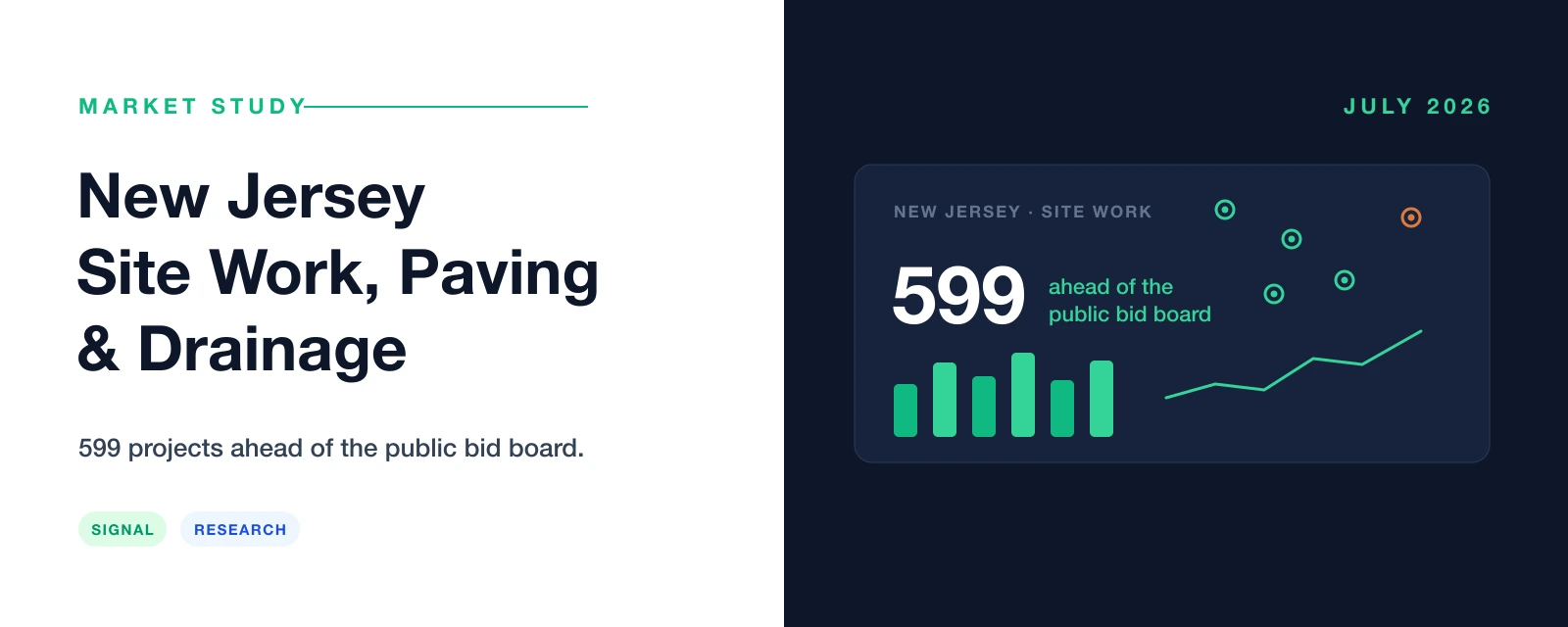
Most of New Jersey's public paving and drainage work is one step away from a solicitation. Of the 797 active site-work, paving, and drainage projects SymplSignal tracks statewide, 599 are still ahead of the public bid board, and 393 of those sit at pre-bid, the last stage before an RFP posts. Behind them are 1,602 public buyers across all 21 counties, led by school districts (279) and municipalities (261).
What pays for a New Jersey road or drainage project
- The Transportation Trust Fund puts $400 million a year into local roads. NJDOT's Municipal Aid program is "a competitive program intended to provide municipalities with transportation based grants to supplement their transportation programs," and starting in FY2018 "the Transportation Trust Fund (TTF) will provide $400 million in State Aid to municipalities and counties for local transportation improvements." Awards are public and dated, so a resurfacing job is on the record well before it bids. That channel is why municipalities (261), county governments (158), and public works departments (146) together form the largest block of buyers here.
- MS4 permits make the drainage work non-discretionary. New Jersey runs three municipal stormwater permits. Per NJDEP, "all three permits authorize the discharge from publicly owned MS4 systems," and "the Tier A Permit applies to a majority of NJ municipalities." Those standing obligations turn aging culverts, outfalls, and detention basins into funded capital projects on a rolling basis, which shows in the buyer mix where water and sewer authorities are the fifth-largest class (149).
- The state lends cheap money for the drainage half. The New Jersey Infrastructure Bank provides "low cost State funds and assistance for Water Infrastructure projects" through the New Jersey Water Bank, alongside a parallel resilience channel. Below-market financing is what moves a deferred stormwater or outfall project out of the backlog and into design.
- School districts are the most numerous buyer class, and a campus is mostly pavement. Districts (279) edge out municipalities on buyer count because a school site is parking, bus loops, walkways, and drainage as much as it is buildings. That is a count of owners, not of volume: individual districts buy less often than a public works department does, but there are more of them, and both funded examples below are school paving packages. In the 31 SDA districts, the NJ Schools Development Authority is "the State agency responsible for fully funding and managing the new construction, modernization and renovation of school facilities projects," so site scope inside a facilities project carries state money with it.
The buyer landscape
Across all 21 New Jersey counties, SymplSignal tracks 1,602 public buyers that procure site work, paving, and drainage: school districts (279), municipal governments (261), fire districts (166), county governments (158), water and sewer authorities (149), public works (146), and parks & recreation (116). Buyer depth is greatest in the South Jersey belt, with Gloucester (147), Burlington (125), Camden (124), Atlantic (116), and Monmouth (110) at the top.
The pipeline
Of 797 active opportunities, 599 are still ahead of the public bid board: funded, proposed, in design, or in pre-bid, upstream of any live solicitation. The distribution is lopsided. Pre-bid alone holds 393, about two-thirds of the ahead-of-bid pipeline, with funding-approved (101), design-in-progress (60), early-signal (36), and funding-proposed (9) behind it. Only 58 are out for bid today and 106 are already under construction.
A pipeline weighted this far toward pre-bid changes the play. These are projects whose scope and money are largely settled and which are waiting on a solicitation rather than on a decision, so the useful lead time is weeks rather than quarters.
The early work does not track the buyer map. Bergen leads with 56 ahead-of-bid projects despite sitting outside the top five for buyer count, followed by Burlington (55), Monmouth (50), Atlantic (42), and Cape May (39), then Camden (34), Morris and Essex (31 each), and Mercer and Gloucester (29 each). North and south are both live.
On project size: only 4 of the 797 tracked opportunities carry a disclosed budget, too few to support a median or a distribution, so this study makes no project-value claims for New Jersey site work.
Representative early-stage projects
- A New Jersey school district: blacktop resurfacing and site enhancements (funding approved)
- A Cape May County port authority: Cape May approach roads rehabilitation (design in progress)
- Linden Avenue roadway improvements: municipal public works (pre-bid)
These are three of 599. The full pipeline, with owner, stage, and county for every project, lives in SymplSignal.
How contractors use this
Work Bergen and the South Jersey cluster (Burlington, Monmouth, Atlantic, Cape May) first, where ahead-of-bid volume concentrates, but cover the state, because all 21 counties carry active work. Because pre-bid holds two-thirds of the early pipeline, the priority here is different from most territories: get positioned on the 393 projects whose solicitations are imminent, and work the 161 funding-approved and in-design projects as the next wave. Read the funding path first, since a Municipal Aid resurfacing job, a Tier A stormwater retrofit, and an SDA-funded school site package are three different sales. New Jersey site work sits at 73% coverage and climbing, so expect this pipeline to grow. See how it works for site work, paving & drainage.