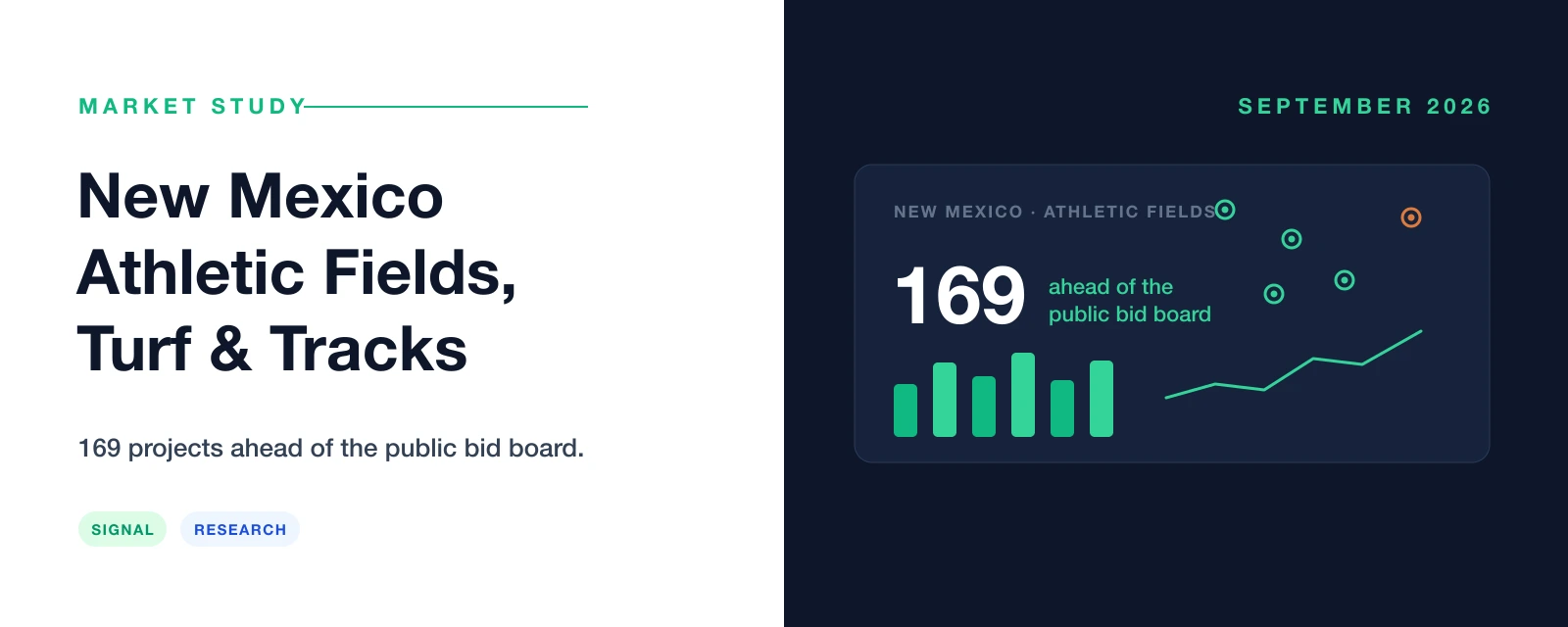
Funding approved is the largest single stage in New Mexico's public athletic-field, turf, and track pipeline: 87 projects have money committed and no RFP posted. In all, SymplSignal is tracking 199 active public projects in this vertical across the state, and 169 of them are still ahead of the public bid board, funded, proposed, or in design before a solicitation exists. Behind them sit 259 public buyers across 32 counties: cities and towns, school districts and charter networks, county governments, and the state's colleges and universities.
Where the field money comes from
- State capital outlay funds local fields as named line items. New Mexico's legislature appropriates capital outlay directly to local projects every session, and the Legislative Council Service's 2026 capital outlay primer lists "park renovations and equipment purchases" among the typical uses, funded from severance tax bonds, nonrecurring general fund revenue, and general obligation bonds. Net severance-tax bonding capacity for 2026 projects was estimated at $1.128 billion, and in March 2026 the governor signed SB 240 and HB 248, more than $1.5 billion for schools, roads, housing, community centers, and water, including $20 million for state parks. An appropriation like that arrives as a specific project with a dollar figure attached, which is why funding-approved (87) is the largest stage in this dataset.
- Every local government files a five-year infrastructure plan first. Counties, municipalities, special districts, and K-12 schools submit an annual Infrastructure Capital Improvement Plan (ICIP) to the Department of Finance and Administration, a rolling five-year priority list that is the first step in the state's capital outlay process. Fields, lighting, and courts appear on those lists years before any RFP; two of the early-stage projects in this pipeline, in Farmington and Roswell, surfaced directly from ICIP submissions.
- School districts pay for grounds through local levies with a state match. The Public School Capital Improvements Act (SB9) two-mill levy and the Public School Buildings Act (HB33) both let districts spend on "purchasing or improving public school grounds," and SB9 revenue carries state matching funds. School districts (81) and charter school networks (24) together account for 105 of the 259 buyers here.
- Albuquerque voters just funded another round. On November 4, 2025, city voters approved $33.78 million in parks and recreation general obligation bonds, a question that names "sports fields" explicitly and includes $4 million for the Ken Sanchez Indoor Sports Complex, with roughly 75 percent of the vote. Bernalillo County is the largest buyer county in the state (28) and second in ahead-of-bid work (17).
Demand underneath the funding is steady. The NFHS 2024-25 participation survey counted 53,116 New Mexico high-school athletes (30,042 boys and 23,074 girls), part of a national record of 8.27 million, and synthetic fields installed through the 2010s are reaching the 8-to-10-year replacement window that Cornell's sports-field program uses in its cost comparisons.
The buyer landscape
Across 32 counties, SymplSignal tracks 259 public buyers that procure athletic-field, turf, and track work: municipal governments (95), school districts (81), charter school networks (24), county governments (19), community colleges (12), parks and recreation departments (10), and universities (8), with port, redevelopment, and special-district buyers making up the rest. Bernalillo County holds the most buyers (28), followed by Santa Fe (19) and Taos (13), then a band of counties at 11 each: Curry, San Juan, Sandoval, Chaves, Lincoln, and Lea. Roosevelt has 10.
The pipeline
Of 199 active opportunities, 169 are still ahead of the public bid board, roughly 85 percent of the live pipeline. Funding-approved holds 87 of them, funding-proposed 34, early-signal 27, design-in-progress 15, and pre-bid 6. Only one project is on a live bid right now; 9 have closed bidding and 17 are under construction. The early-stage work reaches 29 of the 32 counties and concentrates in Doña Ana (18 ahead) and Bernalillo (17), then Sandoval (14), Lea (13), Santa Fe (13), Otero (12), and San Juan (11): the Rio Grande corridor from Las Cruces through Albuquerque to Santa Fe, plus the Permian Basin and the Four Corners.
On project size: 47 of the tracked projects carry a disclosed budget. The median is about $700,000, the disclosed total is roughly $179 million, and the largest single project is $85.5 million.
On timing: most early-stage projects do not yet carry a public milestone date, so timing here is reported by stage rather than by calendar. Under state law, individual capital outlay awards are not disclosed until 30 days after the legislative session ends, so funding-approved entries tend to arrive in a spring batch.
Representative early-stage projects
- Bob Forrest Youth Sports Complex, soccer field synthetic turf project (municipal government) (early signal)
- Paradise Hills Baseball Complex facility improvements (parks & recreation) (early signal)
- Veterans Memorial Field equipment, Questa (municipal government) (funding approved)
These are three of 169. The full pipeline, with owner, stage, and county for every project, lives in SymplSignal.
How contractors use this
Start with Doña Ana and Bernalillo, where the pre-RFP work is thickest, and cover the Sandoval / Santa Fe / Lea / Otero / San Juan band next, but plan for a statewide footprint because 29 counties carry ahead-of-bid work. Engage owners during funding-approved and pre-bid, the 93 projects with money committed or a solicitation imminent and no published RFP, and read the funding path first: a capital outlay line item means a fixed appropriation, an ICIP entry means a stated priority without money yet, a levy-funded district project follows the district's own bond and levy calendar, and an Albuquerque bond project now has voter approval behind it. See how it works for athletic fields, turf, and tracks.