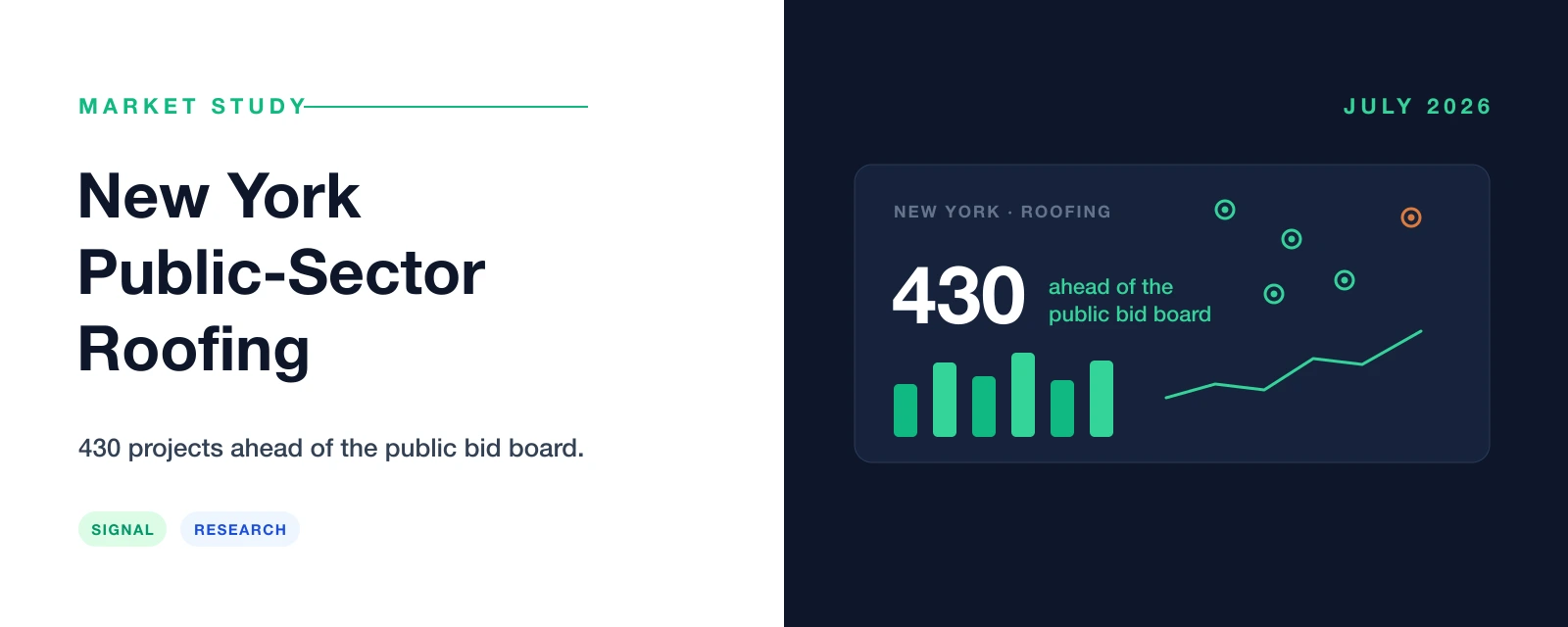
New York has 541 active public-sector roofing opportunities in SymplSignal, and 430 of them are still ahead of the public bid board: funded, proposed, or in design, before an RFP posts. Behind them sit 2,671 public buyers that own and replace roofs across 62 New York counties, a base led not by cities but by the state's fire districts and school districts.
What keeps New York re-roofing
- Roofs sit near the top of a statewide deferred-maintenance backlog. Public roofs age out on a cycle, and the backlog is measurable: the U.S. Government Accountability Office found that about half, an estimated 54 percent, of public school districts need to update or replace multiple building systems, with the building envelope and roofing among the systems most often flagged. That same aging curve runs through New York's fire stations, libraries, and municipal buildings, and the state's freeze-thaw winters and lake-effect snow off Erie and Ontario shorten roof life further.
- New York State Building Aid underwrites school roof capital. The state reimburses a share of district capital construction through Building Aid. The Education Department's Office of Facilities Planning "reviews plans and specifications and issues building permits for capital construction projects undertaken by public school districts and BOCES." Because the aid attaches to bona fide capital construction rather than routine patching, districts move a failing roof into a funded capital project, which is why school districts are the second-largest buyer class here and dominate the early pipeline.
- SUNY's campus capital program keeps institutional re-roofs moving. The State University Construction Fund exists so "continuous and predictable capital investment enables SUNY campuses to sustain a good state of repair." That mandate turns campus roofs into recurring, multi-building programs, and it shows here, where whole-campus "Replace Roofs – Various Buildings" packages are among the largest early-stage projects.
- A re-roof is the cheapest moment to add a cool roof. Per ENERGY STAR, "a cool roof is made of a material or has a coating that can lower the roof surface temperature, decreasing the amount of heat transferred into a residential or commercial building," which cuts cooling costs on public buildings that run all summer.
The buyer landscape
Across 62 New York counties, SymplSignal tracks 2,671 public buyers that procure roofing work: fire districts (525) and school districts (501) lead, then municipal governments (360), public works (294), county governments (239), and library systems (186). Buyer depth is greatest in Westchester (178), Madison (95), Orange (87), Oneida (85), and Erie (80).
The pipeline
All 541 tracked opportunities are active, and 430 are still ahead of the public bid board: funded, proposed, or in design, upstream of any live solicitation. The largest benches are funding-approved (157) and design-in-progress (135), together 292 roofs already funded or on the drawing board, ahead of pre-bid (57), funding-proposed (52), and early-signal (29). The early-stage work leans downstate, where Suffolk, Nassau, and Westchester tie at 25 ahead each, with the five boroughs just behind (Kings 16, New York 15, Bronx 12) and Buffalo's Erie County (17) leading upstate. New-roofing signals cluster into the warm-weather season and peak sharply in July 2026. Of the 210 projects with a disclosed budget, roughly $2.96B in known value, the median runs about $4.45M, pushed high by whole-campus and district-wide programs (with a tail to $200M). A single-building re-roof sits well below that.
Representative early-stage projects
- State University of New York: roof replacements at the Jacobson Faculty Tower and Haggerty Administration Building (funding proposed)
- Alexander Central School District: middle-school roof replacement capital project (design in progress)
- A New York fire district: new firehouse at 164 Main Street (funding proposed)
These are three of 430. The full pipeline, with owner, stage, and county for every project, lives in SymplSignal.
How contractors use this
Anchor downstate in Suffolk, Nassau, and Westchester (25 ahead each) and the five boroughs, where the pre-RFP pipeline is thickest, then Buffalo's Erie County upstate. Staff for a statewide footprint, because all 62 counties are live. Engage owners and their design teams during funding-approved and design-in-progress, the 292 projects with money committed or active design but no published RFP, and read the buyer type first: this is a fire-district and school-district market with a large SUNY/campus layer on top, so the funding path (Building Aid, a SUNY capital package, or a fire-company project) tells you how firm the money is. See how it works for public-sector roofing.