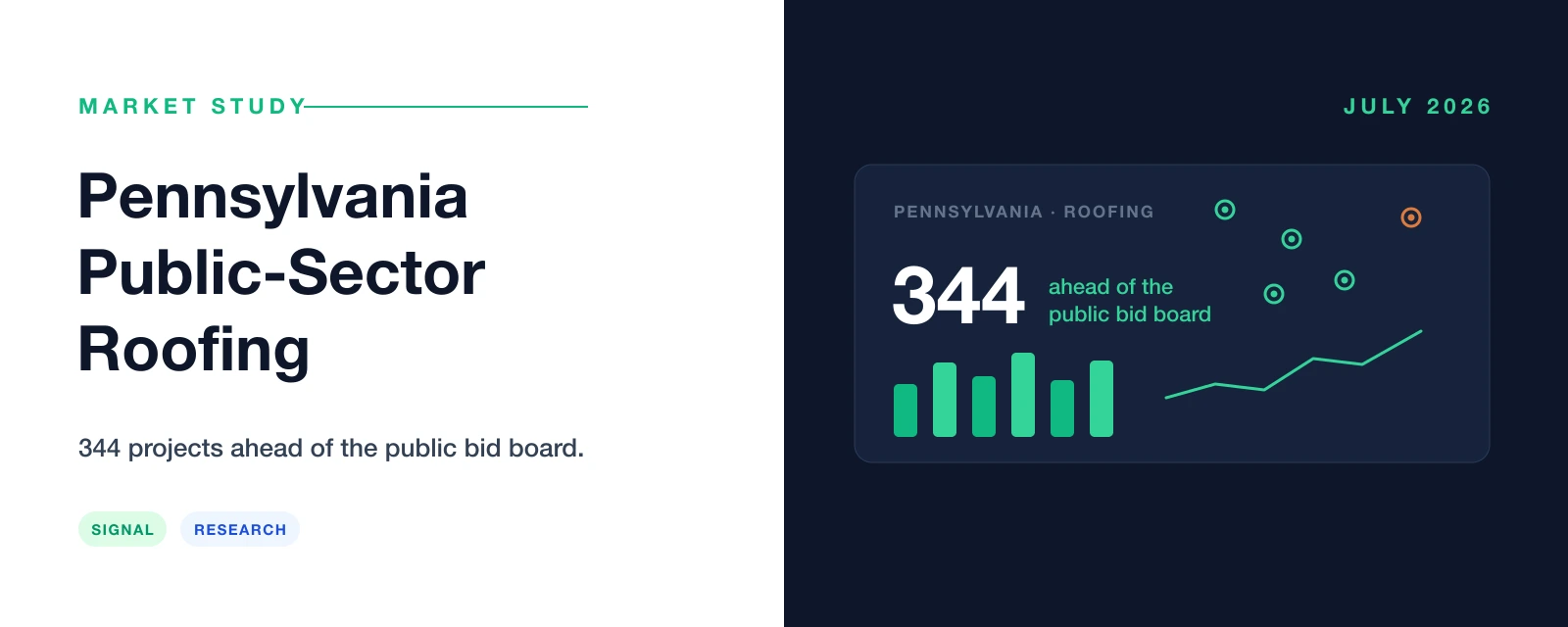
344 of the 461 active public-sector roofing opportunities SymplSignal tracks in Pennsylvania are still ahead of the public bid board: funded, proposed, or in design, before an RFP posts. Behind them sit 3,114 public buyers that own and replace roofs across all 67 Pennsylvania counties, a base led not by school districts but by the state's municipalities, fire districts, and public-works departments.
What keeps the roof work coming
- Roofs are near the top of a statewide deferred-maintenance backlog. Public roofs age out on a cycle, and the backlog is measurable: the U.S. Government Accountability Office found that about half, an estimated 54 percent, of public school districts need to update or replace multiple building systems, with the building envelope and roofing among the systems most often flagged. That same aging curve runs through Pennsylvania's municipal buildings, fire stations, and libraries, and the Commonwealth's freeze-thaw winters and lake-effect snow shorten roof life further, so the pipeline refills year after year.
- PlanCon reimbursement lowers the bar for major roof renovations. On the school side, the state shares the cost of major construction and renovation through PlanCon, "a set of forms and procedures used to apply for reimbursement." When the Commonwealth picks up part of the tab, districts move long-deferred envelope and roof work into design and bid, the stage at which these projects first surface in SymplSignal.
- Roofs travel with air-quality and envelope work. Roofs rarely fail alone. They surface bundled with ventilation and envelope work, where school-health money lands. The EPA's Indoor Air Quality Tools for Schools program ties building condition to a healthy learning environment that reduces absenteeism and improves outcomes, and a failing roof that drives moisture, mold, and ventilation problems is a direct IAQ trigger.
- A re-roof is the cheapest moment to add a cool roof. Per ENERGY STAR, "a cool roof is made of a material or has a coating that can lower the roof surface temperature, decreasing the amount of heat transferred into a residential or commercial building," which cuts cooling costs on public buildings that run all summer.
The buyer landscape
Across all 67 Pennsylvania counties, SymplSignal tracks 3,114 public buyers that procure roofing work. Municipal governments (735) and fire districts (620) lead, then school districts (460), public works (316), county governments (239), and library systems (154). Buyer depth is greatest in Berks (199), Bucks (145), Delaware (140), Montgomery (137), and Chester (135).
The pipeline
Of 461 active opportunities, 344 are still ahead of the public bid board: funded, proposed, or in design, upstream of any live solicitation. The largest single stage is funding-approved (171), money committed with no RFP yet, followed by pre-bid (62), early-signal (38), design-in-progress (37), and funding-proposed (36). The early-stage work is statewide and, unusually for the region, led by Pittsburgh's Allegheny County (20 ahead) rather than the Philadelphia metro, with Westmoreland (14), the Philly-suburb cluster of Montgomery and Delaware (16 each), Lancaster (13), and a northeastern group around Luzerne (12) all live at once. New-roofing signals cluster into the warm-weather construction season and peak sharply in July 2026. Of the 157 projects with a disclosed budget, roughly $752M in known value, the median runs about $625,000, with district- and countywide programs pushing the top to $150M.
Representative early-stage projects
- Weatherly Area School District: elementary/middle-school roof replacement (funding approved)
- Greensburg Hempfield Area Library: roof, masonry, and water-damage repairs, in the Southwest-PA cluster (funding approved)
- West Mahoning Township: municipal building project (funding approved)
These are three of 344. The full pipeline, with owner, stage, and county for every project, lives in SymplSignal.
How contractors use this
Anchor on Allegheny and the Southwest (Westmoreland, Beaver), then the Philly-suburb cluster (Montgomery / Delaware / Chester / Bucks) and Lancaster / NEPA, where the pre-RFP pipeline is thickest. Staff for a statewide footprint, because all 67 counties are live. Engage owners and their design teams during funding-approved and pre-bid, the 233 projects with money in hand or an imminent solicitation but no published RFP, and read the buyer type first: this is a municipal-and-fire-district market before it is a school market, so the funding path (a PlanCon-backed district re-roof vs. a township or fire-company capital project) tells you how firm the money is. See how it works for public-sector roofing.