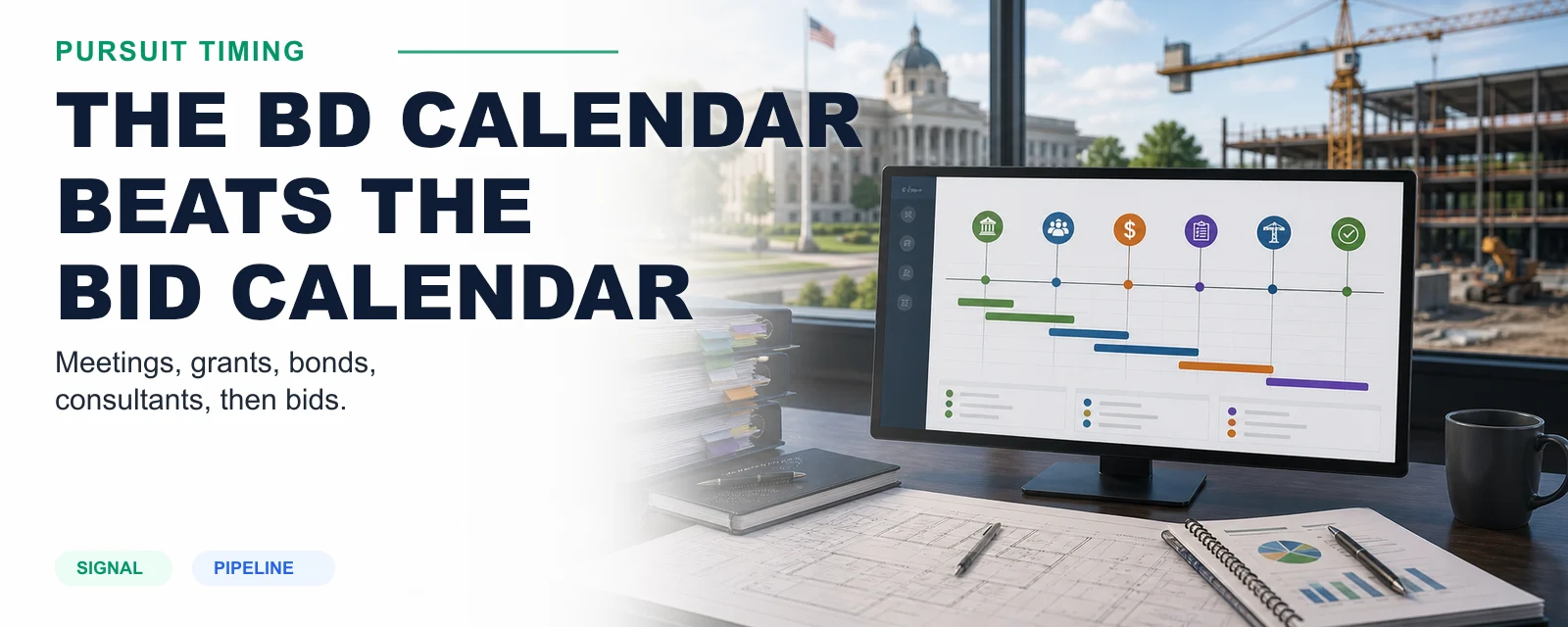
The bid calendar is late.
It tells you when the RFP is due, when questions are due, when the pre-bid walk happens, and when the owner opens responses. That matters, but it is not where the pursuit begins.
The pursuit begins on the BD calendar.
What belongs on the BD calendar
Public construction moves through public rhythms.
School boards meet monthly. Facilities committees meet before full board votes. Cities and counties run budget workshops. Parks commissions review master plans. Bond campaigns have filing deadlines and election dates. Grant programs have application windows and award cycles. Consultants are selected before scope is fully designed.
Those moments are pursuit events.
If you only track bid dates, you miss the earlier decisions that shaped the bid.
Why timing changes the conversation
At the bid stage, the owner is asking for price, compliance, schedule, and responsiveness.
Earlier, the owner may still be asking different questions: What scope should we fund? Should we repair or replace? What will the grant cover? Which consultant should help us? Can this work be phased? How do we avoid future maintenance problems?
That earlier conversation is less crowded and more useful.
A roofing contractor can help a district think through phasing and warranty risk. An HVAC firm can help an engineer understand maintainability. A civil contractor can track drainage studies before they become site-work packages. An athletic-field contractor can watch bond language and park master plans before procurement exists.
The events to watch
A useful BD calendar tracks:
- Board, council, commission, and committee meetings.
- Budget workshops and capital-plan adoption dates.
- Bond votes, bond oversight meetings, and bond-program updates.
- Grant application deadlines and award announcements.
- Consultant RFQs and professional-services awards.
- Design milestones, feasibility studies, and facilities condition assessments.
- Procurement windows once the project becomes formal.
The point is not to attend everything. The point is to know which week matters.
What most teams do instead
Most BD teams rely on memory, relationships, and bid-board alerts.
That can work for a handful of owners. It breaks at territory scale. A team covering 40 school districts, 80 municipalities, and multiple park authorities cannot manually remember every meeting, grant cycle, budget workshop, and consultant approval.
The result is uneven coverage. The team knows a few owners deeply and discovers the rest when procurement posts.
How Sympl Signal helps
Sympl Signal turns public-owner activity into a pursuit calendar.
It monitors the sources, classifies project stage, connects signals to stakeholders, and alerts the team when the next action window opens. The BD calendar becomes evidence-backed instead of memory-backed.
That changes the operating rhythm.
The team can still use bid boards for response management. But the strategic pursuit starts earlier, when the owner, consultant, funding, and scope are still moving.
The firms that win public work do not just respond faster.
They show up earlier.