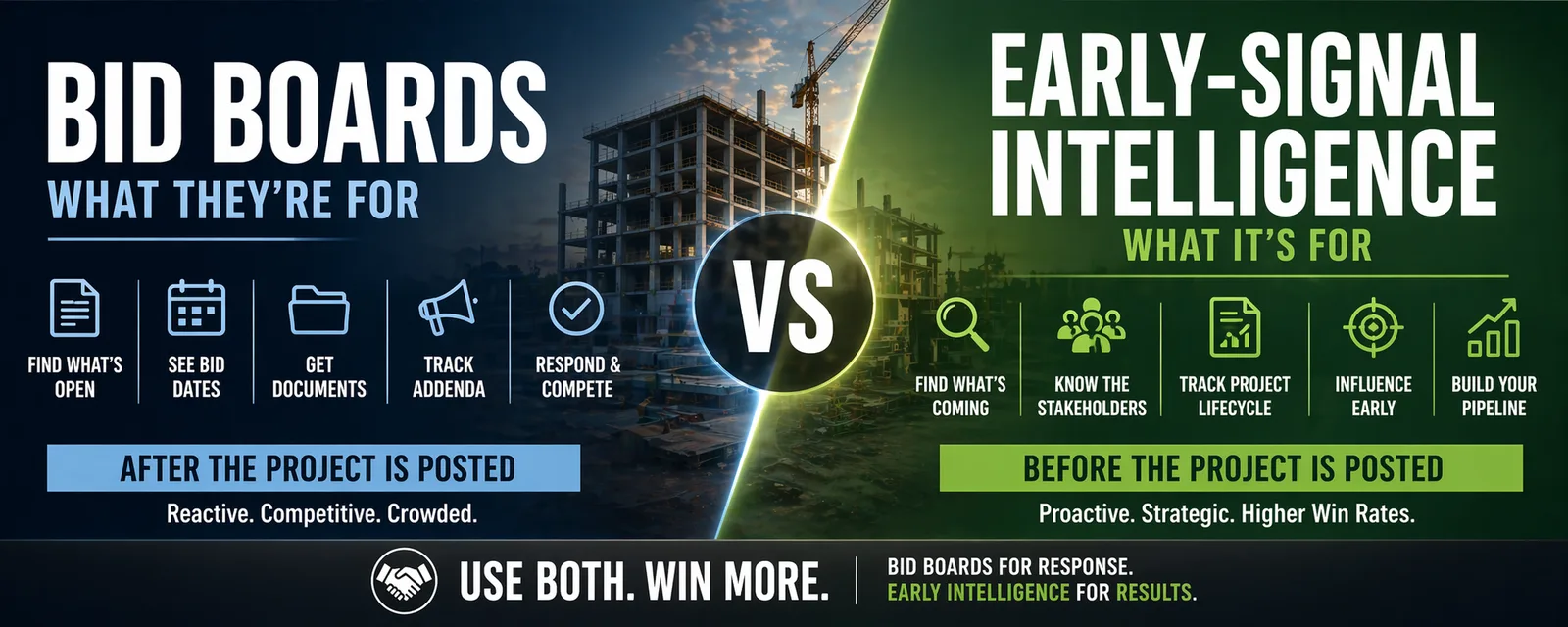
Every few months we get the same question from a construction BD leader: "We already use [Dodge / ConstructConnect / a state procurement portal]. Why do we need something else?"
It's a fair question. The short answer: bid boards and early-signal intelligence aren't competitors. They solve different problems at different stages of the pursuit cycle. The firms that win the most public work use both — deliberately — and know what each is for.
What a bid board is for
Bid boards — whether commercial (Dodge, ConstructConnect, BidOcean) or governmental (state procurement portals, municipal eBid systems) — index opportunities that have already been posted for competitive bidding. They're document routers. Their job is to aggregate procurement documents so you don't miss an RFP, an ITB, or a public-notice advertisement.
Bid boards are excellent at:
- Making sure no open opportunity in your territory goes unseen
- Providing uniform access to procurement documents
- Flagging bid dates and RFI deadlines
- Organizing addenda and amendments
- Supporting a fast, disciplined response-prep workflow
This is genuinely valuable. If you don't have bid-board coverage, you will miss opportunities — and that's table stakes.
What a bid board is not for
Bid boards surface projects after they've been posted. By that point:
- The scope is locked — the owner's consultant wrote it
- The product basis-of-design is specified — often naming a competitor's product
- The short list of likely GCs / subs is already shaped by owner history
- The pricing pressure is maximum — everyone sees the same post
- The relationship advantage is zero — you're one of many responders
You can still win from this starting position. Plenty of firms do. But the margin is thin, the hit rate is low, and the pursuit is exhausting.
What early-signal intelligence is for
Early-signal intelligence watches the public-owner activity before procurement posts. CIPs, bond campaigns, master plans, board meetings, facilities condition assessments, grant awards, A/E selections.
Early-signal intelligence is excellent at:
- Surfacing projects 12–24 months before they post
- Identifying who the owner's consultant is, before the spec is written
- Tracking the lifecycle from "mentioned in a facilities committee meeting" to "A/E selected" to "CMAR RFQ released"
- Mapping stakeholders — facilities director, finance director, consultant, program manager — when it still matters to know them
- Giving BD teams a reason to act on a specific project in a specific week
This is the work that moves a firm from reactive bidding to proactive pipeline.
Where they overlap
They touch at the handoff. A project that early-signal intelligence flagged 18 months ago will eventually post on a bid board. At that moment, you want both tools:
- The bid board delivers the actual RFP documents, deadlines, and addenda
- Your pre-bid research gives you the relationship, the scope context, and the pricing posture to win
When to use which
Use a bid board for:
- Bid-response operations — making sure your response team sees everything open
- Backfill coverage on territories or buyer types you don't pursue actively
- Commodity work where relationships don't move the needle
Use early-signal intelligence for:
- Strategic pursuit on your highest-value buyer types
- Consultants, ESCOs, or program managers you want to influence before spec
- Territory-level pipeline — the 40–80 public owners you'd have to hire ten BDs to cover manually
The punchline
A bid board without early intelligence leaves you pursuing the crowd's projects on the crowd's terms. Early intelligence without a bid board leaves gaps in your operational response. The firms consistently winning public work run both — and spend most of their pursuit energy in the stage the bid board can't see.