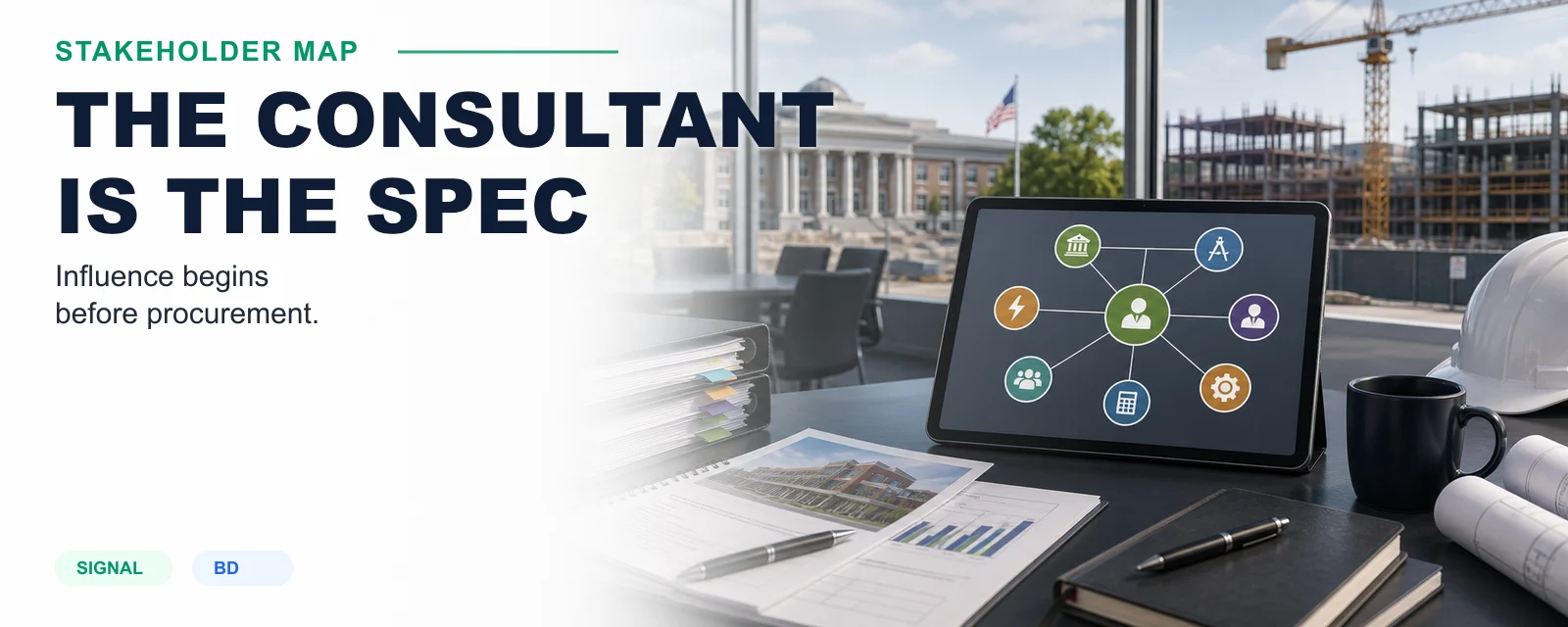
In public construction, the owner signs the contract, but the consultant often shapes the opportunity.
The architect, engineer, roofing consultant, ESCO, owner's rep, program manager, or specialty designer may define the basis of design, write the study, recommend the phasing, draft the budget, and frame the scope long before procurement opens.
By the time the bid board lights up, much of the influence window is gone.
Why consultants matter
Public owners rarely move from "we have a problem" to "we have a bid package" without help.
A school district may hire a facilities consultant to study roofs, HVAC, athletic fields, or deferred maintenance. A city may hire an engineer for drainage, paving, bridges, or utilities. A hospital may bring in a design team for compliance-heavy renovations. A park district may use a landscape architect for master planning and grants.
Those consultants translate needs into scope.
They also create the artifacts business development teams should care about: studies, board recommendations, concept budgets, phasing plans, design contracts, meeting exhibits, and procurement timelines.
The mistake most firms make
Most firms start relationship-building after the project is formally out.
At that point, the consultant may already understand the owner's preference, risk tolerance, budget ceiling, and approved approach. The specification may reflect products, assemblies, details, or methods discussed months earlier. The owner may already trust a short list of advisors.
You can still compete. But you are competing from the outside.
What to map
A good pre-bid stakeholder map should identify more than the owner contact.
Track:
- The facilities director, public works director, superintendent, city manager, or department head who owns the problem.
- The finance or grants person tied to funding.
- The architect, engineer, ESCO, consultant, or owner's rep shaping scope.
- The board, council, commission, or committee where approvals happen.
- Any incumbent vendors or service contractors with operating knowledge.
- The procurement contact who will eventually manage the formal process.
The goal is not to spam everyone. The goal is to understand who can change the shape of the project before that shape is locked.
What to do when you find the consultant
Early outreach should be useful, not pushy.
Share relevant project experience. Offer field observations. Ask how they are thinking about phasing, constructability, warranty, lifecycle cost, or owner maintenance burden. If you are a specialty contractor or product vendor, help them avoid details that create maintenance problems later.
The best firms do not wait for the RFP to ask, "Who wrote this?"
They know because they were watching when the consultant was selected.
How Sympl Signal helps
Sympl Signal connects project signals to people.
When a board approves a facilities study, Signal captures the source evidence, identifies the consultant where available, tracks the stage, and ties the stakeholder map to the opportunity. BD teams can see not only that a project exists, but who is shaping it and what action makes sense now.
That is the difference between a lead and a pursuit.
The bid board tells you when procurement begins. The stakeholder map tells you where influence began.