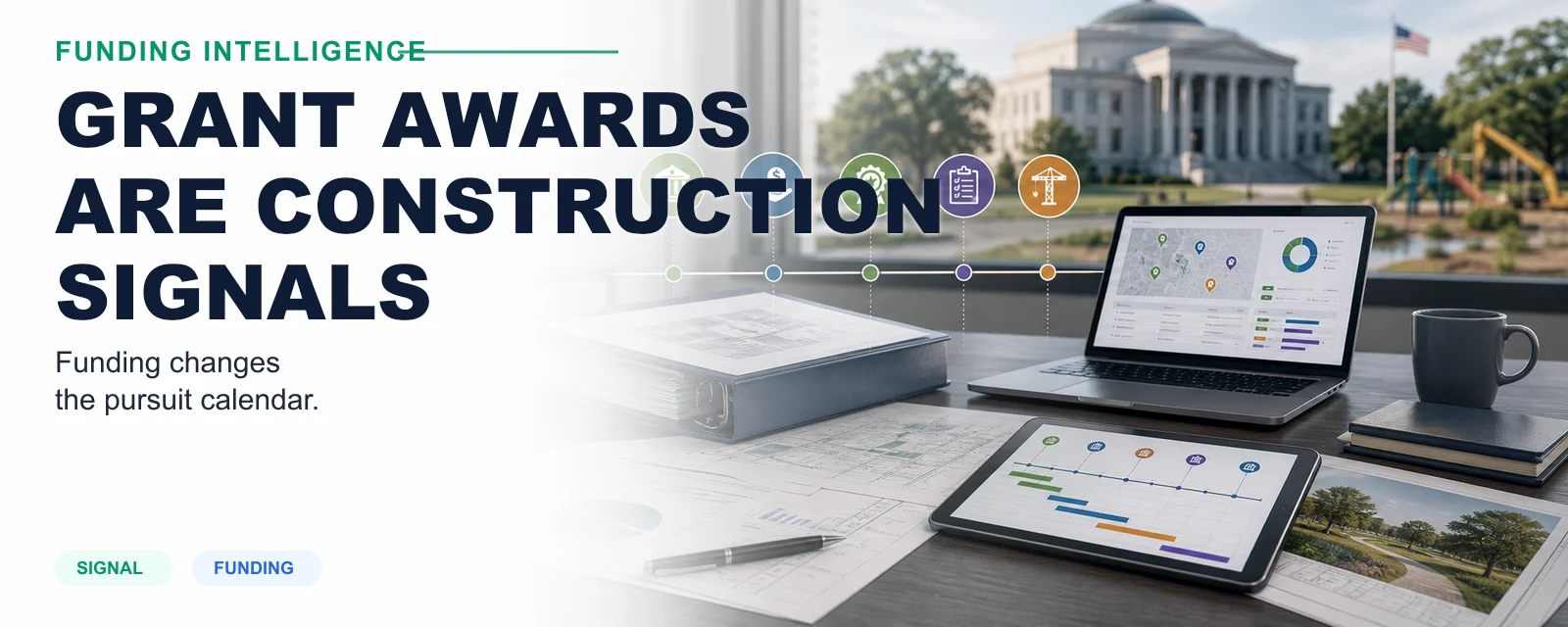
A grant award is not just a press release.
For construction BD teams, it is a timing signal.
Public owners use grants to fund parks, trails, HVAC upgrades, stormwater work, energy improvements, resilience projects, athletic facilities, safety upgrades, and public buildings. The award often arrives before the formal procurement. It may name the site, scope, budget, matching funds, deadline, and agency requirements.
That is enough to start a pursuit.
The important point is that grant information is usually operationally specific. Notices of funding opportunity describe eligible project types, deadlines, match requirements, scoring criteria, and reporting obligations. Award lists often name the recipient, program, amount, and funded purpose. For a BD team, those are not administrative details. They are clues about urgency, scope, constraints, and the next public decision.
Why grant signals are valuable
Grants compress uncertainty.
Before funding, a project may be only a wish list item. After an award, the owner has external money, reporting obligations, and a reason to move. The project is still not always guaranteed, but it is more real than a generic capital-plan line.
For BD teams, grant signals answer several questions:
- Is the owner serious?
- What scope was funded?
- What is the budget range?
- What timeline or reporting deadline exists?
- Which agency or program created the funding?
- Will matching funds, board approval, or design work be needed next?
Those answers shape outreach.
Where grants show up
Grant signals are scattered.
They can appear in state agency award lists, federal program announcements, municipal agendas, school board packets, park commission minutes, capital budgets, bond updates, consultant reports, and local news.
That dispersion is the problem. A contractor selling across multiple counties can miss a meaningful signal simply because it was posted as a PDF attachment to a committee agenda rather than a bid listing.
How to read the signal
Not every grant award means "call the owner today and pitch."
Read the stage.
If the grant funds planning or design, the next move may be to identify the consultant selection window. If it funds construction, the project may be heading toward procurement faster. If the award requires match funding, watch the next board or council meeting. If the grant has a reimbursement deadline, the owner may be under pressure to obligate funds quickly.
The value is not just knowing that money exists. It is knowing what the money does to the calendar.
Common grant-driven project categories
Some categories produce especially useful early signals:
- Parks, trails, athletic fields, courts, playgrounds, and outdoor amenities.
- K-12 HVAC, indoor air quality, and energy upgrades.
- Stormwater, drainage, resilience, and flood mitigation.
- Brownfield remediation and site redevelopment.
- Municipal buildings, public safety facilities, and community centers.
- ADA transition plan work and accessibility improvements.
Each has different funding sources, but the BD pattern is similar: funding appears before procurement, and the first firms to understand the funded scope have a better chance to position.
How Sympl Signal helps
Sympl Signal monitors grants as part of the public-project lifecycle.
It does not treat an award as a standalone news item. It ties the award to the owner, project, stage, sources, stakeholders, and likely next action. If a grant moves a project from vague need to funded scope, Signal shows that movement.
That is what BD teams need.
A grant award tells you the project has oxygen. Signal tells you what to do before everyone else sees the smoke.