A synthetic turf field costs $900K to $1.4M. A rubberized track replacement runs $400K to $700K. A full stadium upgrade can clear $10M. These aren't numbers a school district finds in the operating budget. Athletic facilities get replaced through a specific set of funding mechanisms, and each one produces its own set of pursuit signals.
If you sell turf, tracks, or athletic construction to K-12 buyers, you need to read the funding source as carefully as the scope.
The five funding mechanisms
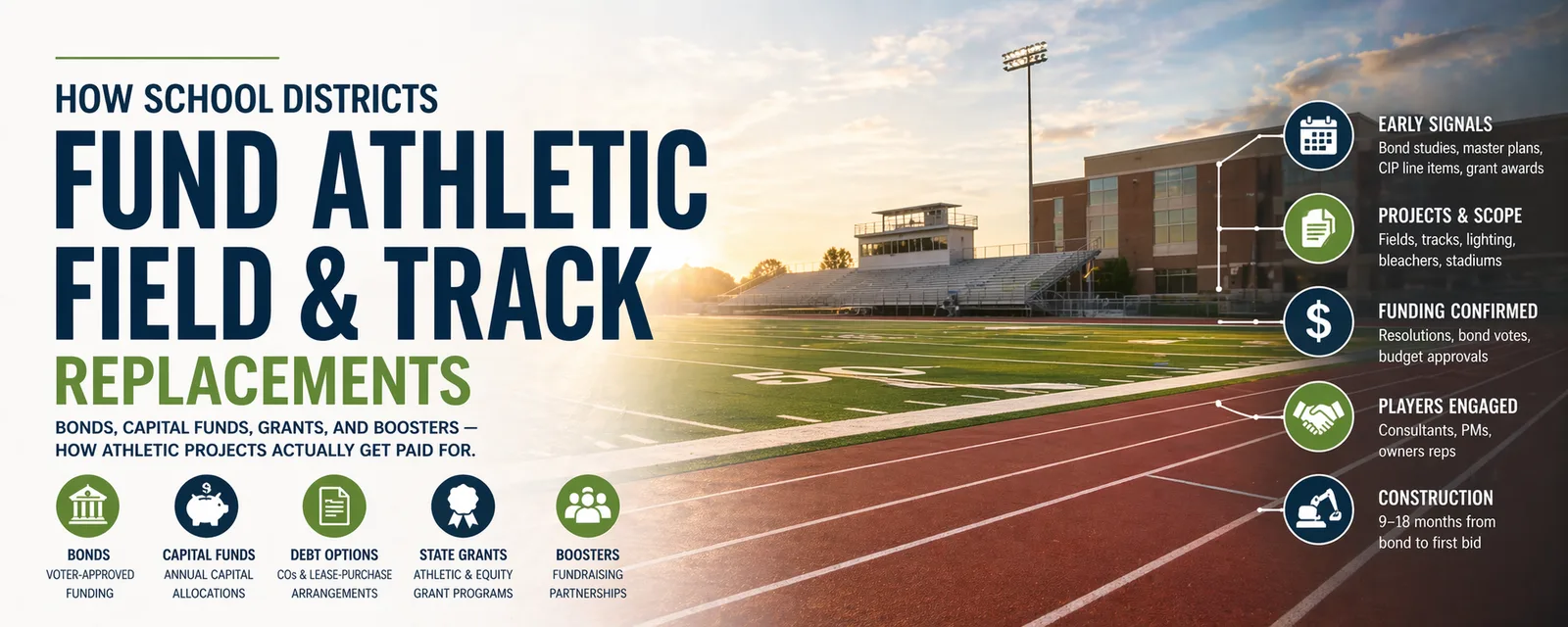
Most athletic replacements are funded through one of these paths:
- General obligation bonds. The biggest source of athletic money. Voters approve a bond package; a subset of the dollars is earmarked for athletic facilities. Bond language is public and usually specific — "Proposition B, $14M for athletic facility improvements including turf replacement at X, Y, Z high schools."
- Capital project funds. Annual capital allocations from the general fund. Lower dollar amounts, usually reserved for single-school projects or partial phases.
- Certificates of obligation and lease-purchase arrangements. Debt instruments that don't require a voter referendum. Used when a district needs to act faster than the next bond cycle allows.
- State athletic or equity grants. Varies by state. Some states have dedicated athletic facility grants; more commonly, Title IX equity studies drive grant-funded corrective projects.
- Booster / fundraising partnerships. Occasional, usually partial — a booster club funds lighting while the district funds the field.
How each funding mechanism signals
- Bond campaigns. Watch for feasibility studies, demographic studies, and facilities master plans — these usually precede a bond vote by 12–18 months. Once the bond is being drafted, project lists get attached to board resolutions.
- Capital project funds. Show up as line items in the district's CIP. Read the CIP. Follow up with the facilities department on specific line items.
- Certificates of obligation. Appear as board resolutions authorizing issuance. The attachment usually lists the projects being funded.
- State grants. Grant application deadlines and award announcements are public. Set alerts on the state education agency's grants page.
What to ask when a signal appears
For any athletic funding signal, you want to know:
- What specific facilities are on the list? A bond that funds "athletic facility improvements" covers a lot. The staff report attached to the board resolution usually names specific schools and scopes.
- What's the issuance schedule? Bonds are issued in tranches. The project schedule follows the issuance schedule, not the vote date.
- Is there a design consultant engaged yet? Athletic work is often specified by an athletic facility consultant. Find out who.
- Is there a program manager? Districts running multi-year bond programs often hire an owner's-rep to coordinate. That person usually controls which contractors get seen.
- Has the district run a Title IX equity study recently? If yes, the study often drives scope — girls' softball, visitor-side track resurfacing, restroom additions.
The pattern to watch
The highest-value athletic pursuit pattern: a district passes a bond that includes athletic facilities, engages an athletic facility consultant for the design, and phases construction across three fiscal years. From the day the bond passes to the day the first turf project bids is usually 9–18 months. A firm that shows up at bid has missed the decisive window. A firm that shows up the week after the bond passes has a year to influence the outcome.