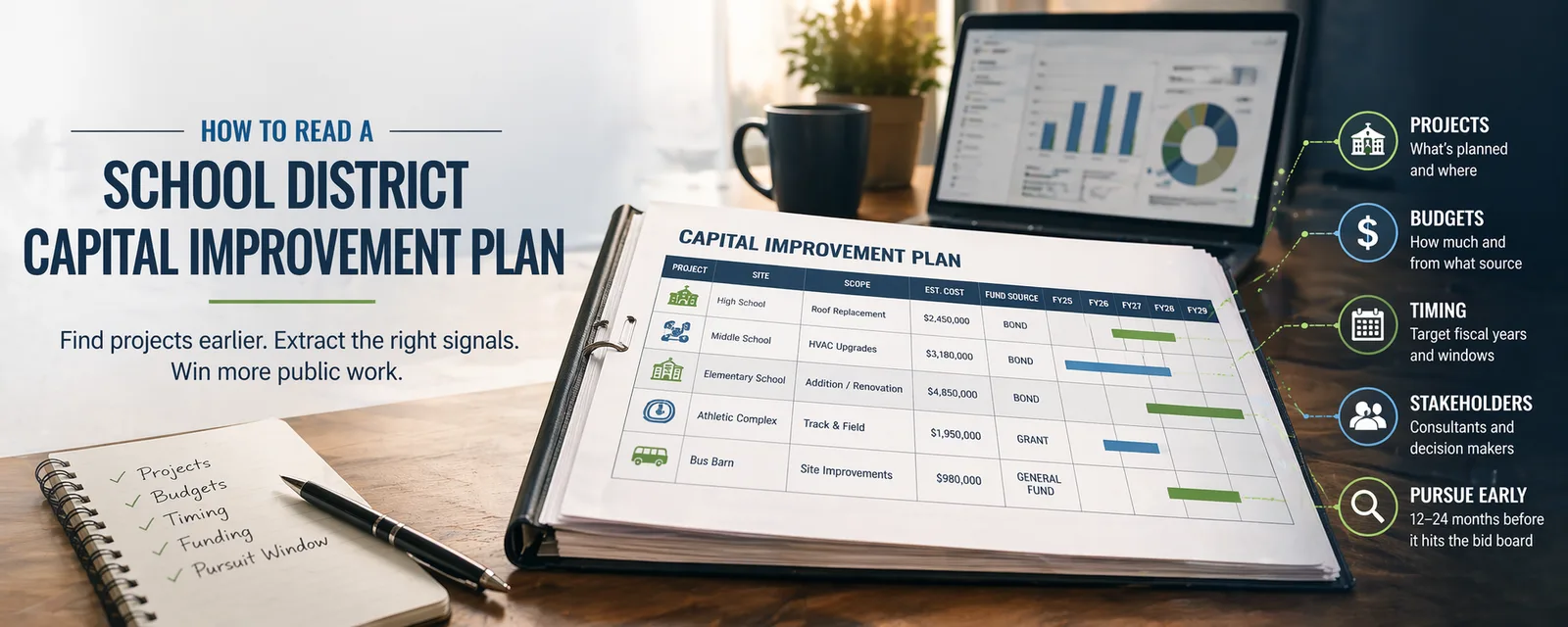
A Capital Improvement Plan is the single most useful document a public owner publishes. It names projects, dollar amounts, and target years — usually 12–24 months before any of it hits a bid board. And yet most construction firms either don't look at CIPs, or can't read them well enough to extract pursuit-grade intelligence.
This is a practical guide to reading a school district CIP. The same patterns apply to municipal, county, and park-district CIPs.
What a CIP actually is
A Capital Improvement Plan (sometimes called a Capital Improvement Program, or five-year capital plan) is a rolling budget document. It lists the capital projects the owner plans to fund over a forward horizon — typically five years, sometimes ten. It's updated annually in most districts, and it's a public document.
The CIP is not a bid schedule and it's not a commitment. Projects get added, deferred, combined, or dropped. But it's the best forward view of a district's construction intentions that exists.
Where to find it
Most districts publish the CIP on their website, usually under Business Services, Finance, or Facilities:
- Board packet attachments from the annual budget meeting
- Facilities department or Operations department pages
- Superintendent's recommended budget documents
- Bond program websites (if a bond is active)
If you can't find it on the website, file an open-records or FOIA request. Districts almost always have one.
Reading the document
A CIP typically has three layers:
- Summary tables — totals by year, by fund source (general fund, bond, grant, impact fees).
- Project-level line items — one row per project, with name, site, scope description, dollar amount, target fiscal year, and fund source.
- Narrative sections — explaining why a project is included, what's driving it, and sometimes naming the consultant who produced the underlying study.
The line items are the gold. Everything else is context.
What to extract
For each relevant line item, capture:
- Project name and building/site. A line item like "Roosevelt HS — Roof replacement — $2.4M — FY27" tells you the specific campus, scope, size, and timing.
- Fund source. Bond-funded projects behave differently from general-fund projects. Bond projects usually have to be procured faster.
- Fiscal year. A "FY27" line item in a district with a July fiscal year means the project needs to be procured by mid-2027. Design selection happens 12–18 months before that. Your outreach window starts now.
- Delivery method signals. Some CIPs note design-bid-build, CMAR, or design-build. If not stated, check the district's past project history.
- Underlying study. "Per the 2024 FCA" tells you who did the assessment. That consultant is often the path into the project.
Common patterns to flag
- Multiple buildings, same scope, same year. A district planning to reroof three schools in FY27 is a single procurement opportunity — not three separate ones. Bundle your pitch.
- A scope category growing year over year. If HVAC spend jumps in FY26 after a decade of low investment, something changed — an audit, a bond, a new facilities director. Find out what.
- A scope with no consultant named. A line item without a named consultant is usually a placeholder — the district is still deciding what it wants. That's your earliest opportunity to influence.
- Deferred projects. Projects pushed from FY26 to FY28 often come back with revised scope. A re-planned project is a fresh pursuit window.
Turning a CIP into action
Reading one CIP is a research exercise. Reading CIPs across 40 districts in your territory, every annual refresh, and correlating them with board minutes, consultant engagements, and grant awards — that is a pipeline.
The firms that do this by hand usually cover 3–5 districts well and guess at the rest. The firms that do it systematically cover the full territory and act on the signals that matter.