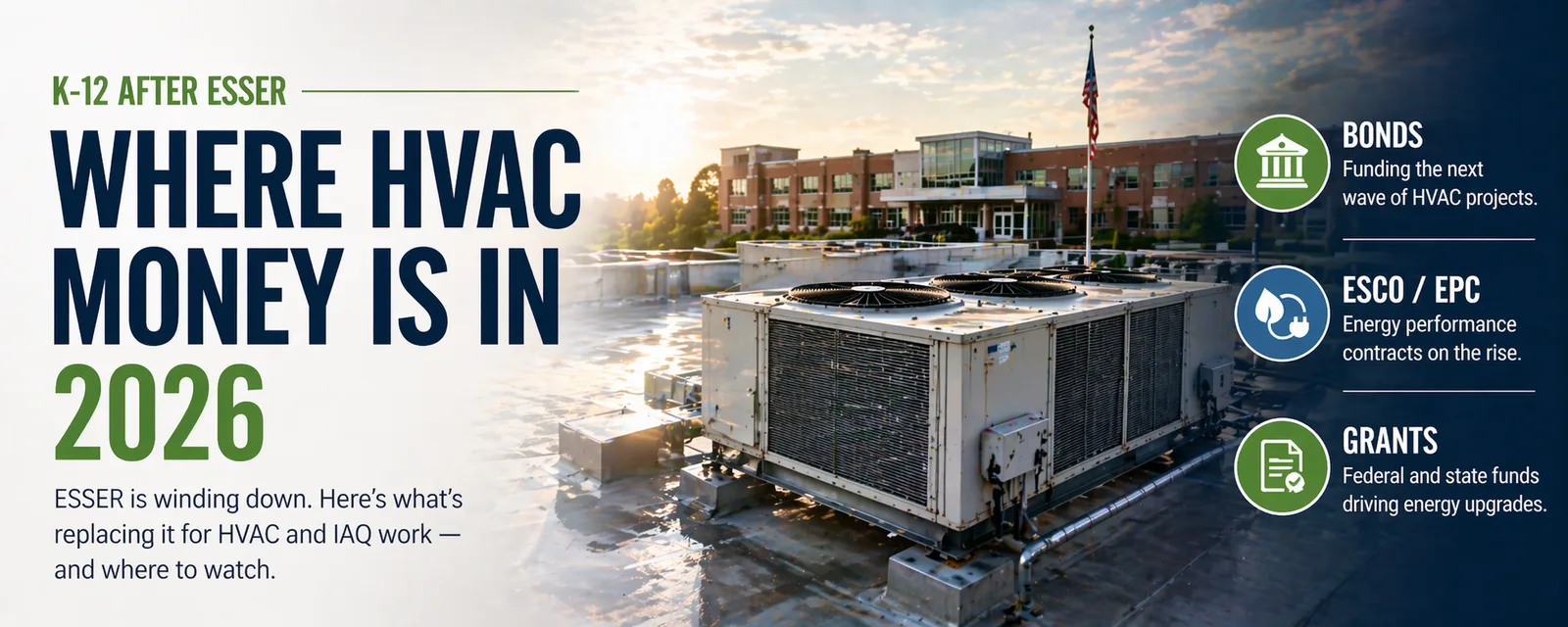
For four years, ESSER dollars carried K-12 HVAC. Between 2020 and 2024, districts used Elementary and Secondary School Emergency Relief funds to replace aging air handlers, upgrade filtration, and retrofit ventilation systems at scale. It was the single biggest injection of capital into K-12 mechanical work in a generation.
That era is ending. ESSER III obligation deadlines have passed in most states, with final liquidation schedules closing out through 2025–2026. What replaces it?
The replacement funding sources
Five categories are picking up the slack, roughly in order of dollar volume:
Bond programs
Bonds are the single biggest replacement. School districts that ran HVAC projects on ESSER money are now putting HVAC into their next bond packages. Watch for bond feasibility studies, facilities master plan refreshes, and bond committee meetings. Bond-funded HVAC tends to bundle — boilers, chillers, AHUs, controls, and envelope upgrades on the same project.
Energy performance contracts (EPCs) and ESCO programs
ESCO activity is rising for exactly the reason you'd expect: state energy offices are pushing guaranteed-savings programs to backfill the ESSER gap. Districts that don't have bond capacity can finance HVAC through an energy performance contract, where the ESCO guarantees savings and the district pays over 10–20 years.
Signals: board resolutions authorizing "investment grade audits," RFQs for ESCO services, ASHRAE Level 2/3 energy audit reports in board packets.
DOE Renew America's Schools
The federal Renew America's Schools Prize and related IRA-era programs funnel energy-retrofit dollars into K-12. Grant awards are public. Check the DOE Office of State and Community Energy Programs grant dashboards. Awards typically precede construction by 12–24 months.
State energy and resilience grants
Many states run their own energy efficiency and resilience programs, funded by state energy offices, public benefit charges, or IRA pass-throughs. Awards are public and typically listed on state energy office websites.
Deferred-maintenance carveouts and specific appropriations
Some states direct specific capital appropriations at school deferred maintenance. These are slower to ramp but meaningful for smaller districts that lack bond capacity.
What changed about pursuit
A few things shifted in 2025–2026 that BD teams should internalize:
- Projects bundle more. ESSER favored targeted upgrades. Bond-funded work favors bundled scope. Prepare to bid boilers and AHUs and controls together.
- Timelines stretch. ESSER's obligation deadlines compressed procurement. Bond programs and EPCs have longer timelines, which rewards earlier outreach.
- ESCOs matter more. The ESCO bench list is the shortcut into a lot of future work. Getting on the bench at the dominant regional ESCOs is a higher-leverage pursuit than any single district.
- The "investment grade audit" is the key signal. An IGA is the earliest reliable marker that a district will procure HVAC work through an EPC in the next 12–18 months.
Where to watch
For a typical K-12 HVAC pursuit territory, the highest-signal documents to monitor:
- Bond feasibility studies and bond campaign launch announcements
- Board resolutions authorizing IGAs or engaging ESCOs
- Facilities master plan refreshes
- State energy office grant award lists
- Federal Renew America's Schools award announcements
- Facilities condition assessments (often precede bond and EPC decisions)
ESSER was a four-year sugar high. The underlying replacement cycle is still there — it just flows through more channels, with longer timelines and higher planning overhead. Firms that adapt their pursuit rhythm accordingly will keep winning.