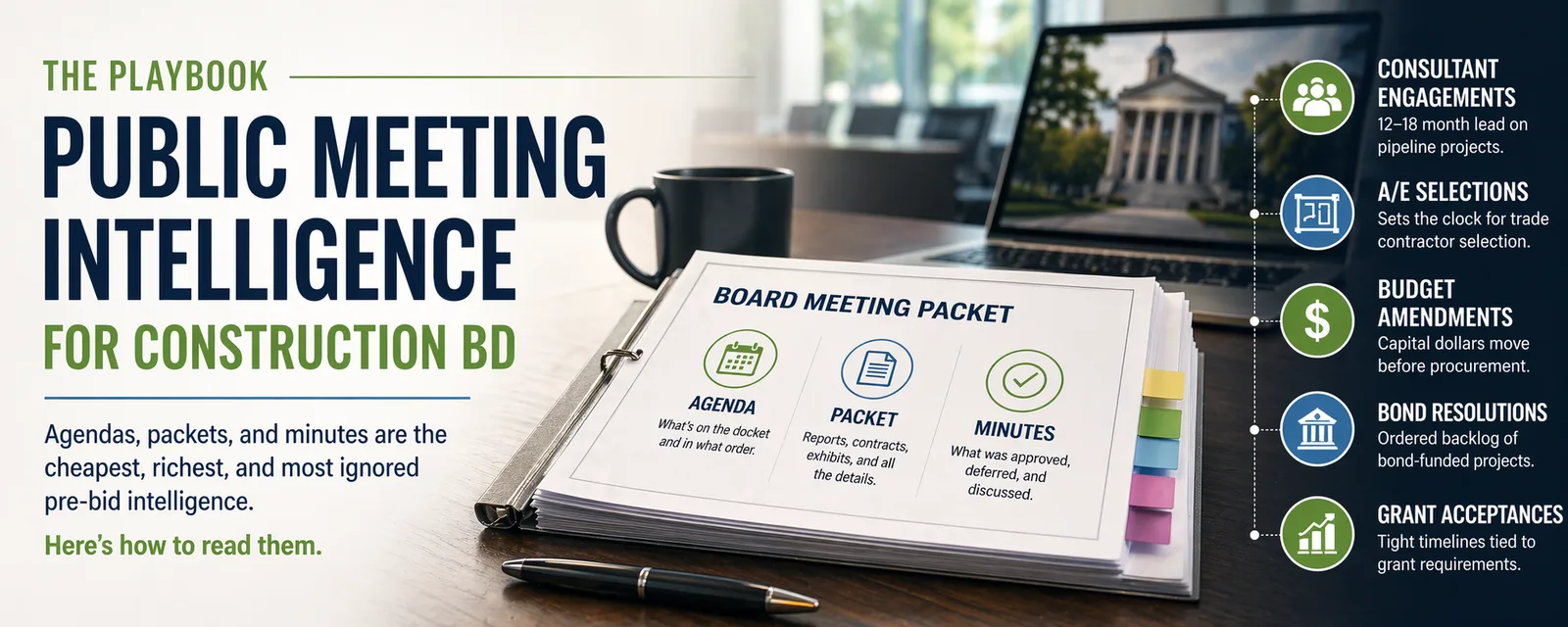
Public meetings are the richest, cheapest, least-used source of pre-bid construction intelligence in the country. School boards, city councils, park commissions, and facilities committees publish their agendas, their packets, and their minutes — often weeks in advance, almost always free. Yet most construction firms never read them.
This is a playbook for turning public meetings into pipeline.
Why meetings matter
Almost every public construction project passes through a meeting before it passes through procurement. The consultant contract gets approved at a meeting. The bond language gets adopted at a meeting. The A/E selection is announced at a meeting. The CMAR is awarded at a meeting. A motivated BD team that watches meetings can see a project's entire pre-procurement life play out in public.
The mechanics are boring — and that's exactly why the intelligence is available.
The three documents that matter
Each public meeting generates three artifacts worth watching:
- The agenda. Published 3–7 days in advance in most jurisdictions. Tells you what's on the docket.
- The packet. Often a 200+ page PDF attached to the agenda. Contains staff reports, contract documents, consultant proposals, budget amendments, and exhibits. This is where the detail lives.
- The minutes. Published after the meeting. Tells you what was approved, what was deferred, and what was discussed.
The packet is usually the most valuable. A single packet can contain the full scope of an upcoming multi-million-dollar roofing program, complete with consultant-drafted specification language.
Which meetings to watch
- School district board meetings: typically monthly. Facilities committee meetings are often biweekly and more detail-rich.
- City council meetings: usually weekly. Watch consent agendas (where small contracts get approved in bulk) and capital budget workshops.
- Parks & Rec commission meetings: monthly. Often the clearest view of park master-plan progress and grant applications.
- Bond oversight committee meetings: when a bond is active. Most important source for bond-funded projects.
- Facilities / buildings & grounds committees: the working body that actually drafts recommendations. Where scope is discussed before the full board votes.
Signals to extract
Scan each packet for:
- Consultant engagements. "Approve contract with [firm] for facilities condition assessment" is a 12-month lead on a pipeline of replacement projects.
- A/E selection. "Approve architect for new elementary school" sets the clock for trade-contractor selection about 12–18 months later.
- Budget amendments. Moving money into a capital line item means something's about to be procured.
- Bond resolutions. "Authorize issuance of $X in bonds" with a project list attached is a complete, ordered backlog.
- Grant acceptances. "Accept FEMA BRIC grant of $Y" — the agency reports progress to the grantor, creating a tight timeline.
- Study commissions. "Authorize facilities master plan" is the earliest possible signal — 18–24 months of project visibility ahead of any procurement.
How to do this at scale
One BD manager covering a 40-district territory can read three districts' board packets well. The other 37 become research debt. In practice, that means the firm sees about 8% of what's happening in its territory.
Systematic coverage requires either a large BD team with territory-split discipline, or AI that ingests public meeting artifacts across a territory, tags them, and surfaces the ones that contain construction signals.
Start small
If you've never done this before, start with five districts you already sell into. Subscribe to their board calendars. Pull the packets for the next three board meetings. Read the facilities-committee agendas. Write down every contract, consultant engagement, and project mention.
You'll find projects. Then you'll find the scale problem — and at that point, you'll know what systematic coverage actually costs, and why it matters.