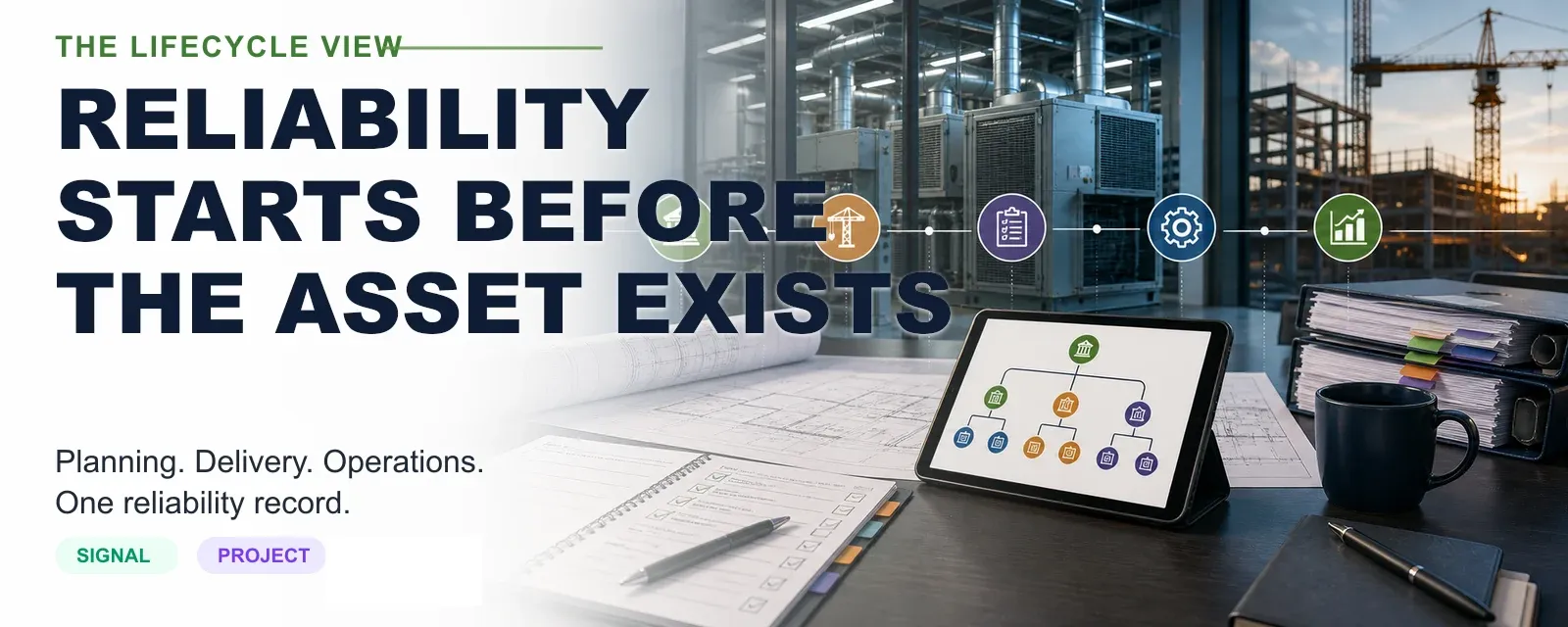
Most software treats reliability as a maintenance problem.
The asset exists. It is installed. It fails. A technician opens a work order. The CMMS records what happened. A reliability engineer reviews the history later and tries to explain why the asset is behaving badly.
That is useful, but it is late.
Reliability is shaped before the first work order is ever written. It is shaped when a public owner decides whether to replace a roof or patch it for another cycle. It is shaped when an engineer writes the basis of design. It is shaped when a contractor submits equipment data, when a commissioning agent verifies performance, when warranty terms are accepted, and when the closeout package lands with the facilities team.
By the time operations inherits the building, many reliability decisions have already been made. The question is whether the data survived the handoff.
The old model: reliability begins after turnover
The traditional software boundary is clean on paper and destructive in practice.
- Business development watches for work.
- Project teams deliver the work.
- Facilities teams operate the asset.
- Reliability teams analyze whatever data made it into the CMMS.
Each group uses different tools, different identifiers, different documents, and different incentives. The handoff between them is usually a PDF package, a spreadsheet, a file share, or a meeting where everyone agrees the data is "in the binder."
The binder is not the reliability record.
A closeout binder can contain the right information and still fail operationally. Model numbers are trapped in PDFs. Warranty terms are not connected to assets. Recommended PM intervals are buried in O&M manuals. Commissioning exceptions are not visible to technicians. Spare parts lists do not become inventory records. The CMMS starts empty or partially populated, then spends its first year accumulating avoidable errors.
That is why many maintenance teams spend months after turnover doing clerical reconstruction: retyping equipment, guessing hierarchy, hunting manuals, and asking contractors for clarification on assets that are already in service.
The reliability record starts upstream
A reliability record is not one table in a CMMS. It is the chain of evidence that explains what an asset is, why it exists, how it was specified, how it was installed, how it was commissioned, how it should be maintained, and how it has actually performed.
That chain begins upstream.
In planning, the owner decides which assets deserve capital attention. A facilities condition assessment, energy audit, capital improvement plan, bond package, or grant application reveals the operating problem that construction is supposed to solve.
In design and procurement, the owner and consultant turn that problem into scope. Product basis, performance requirements, delivery method, commissioning expectations, and warranty requirements begin to define the future maintenance burden.
In construction, submittals become the source of truth for the equipment that will eventually be operated. This is where manufacturer, model, serial range, performance data, O&M documentation, recommended maintenance, approved substitutions, attic stock, and warranty terms appear.
In commissioning and closeout, the installed asset is verified. Deviations, test results, training records, punch items, and final documentation determine whether operations receives a reliable asset or a mystery object with a PDF attached.
In operations, the CMMS should not be starting from zero. It should be receiving the structured history that already exists.
Why this matters to reliability teams
Reliability analysis depends on context. A failure mode means more when the analyst knows the asset class, duty cycle, installation date, commissioning results, PM strategy, warranty status, and whether the installed equipment matched the approved submittal.
Without that context, the CMMS record becomes a partial memory. It may show that an air handler failed three times in six months, but not whether it was value-engineered during procurement, installed with a commissioning exception, or maintained from a generic PM template that ignored the manufacturer's actual requirements.
That missing context changes decisions.
The team may blame technicians for repeat failures when the problem was an installation defect. They may buy parts unnecessarily while the asset is still under warranty. They may defer replacement because the cost history is attached to the wrong parent asset. They may miss an early-life failure pattern because the equipment was never grouped by model or installation cohort.
Reliability is not only about predicting failures. It is about preserving enough structured evidence to make better lifecycle decisions.
Signal: find reliability work before scope locks
Public capital projects do not appear from nowhere. They usually surface in board meetings, capital plans, bond programs, grant awards, facility assessments, and budget documents long before procurement opens.
For contractors and vendors, that early visibility is a business development advantage. For owners and operators, it is also a reliability advantage.
If a district is planning HVAC replacements, roof work, athletic field upgrades, or utility improvements 18 months before bid, the future reliability burden is already visible. The owner can influence scope before the consultant finishes the spec. Operators can push for maintainable equipment, useful warranty language, standardized asset classes, and closeout requirements that will actually land in the CMMS.
Sympl Signal is built for that upstream window. It monitors public sources, classifies opportunities by stage, maps stakeholders, and shows the evidence behind each signal. The same intelligence that helps a contractor pursue early also helps reliability-minded owners understand what future operating assets are entering the pipeline.
Project: preserve reliability data during delivery
Construction project management systems often treat submittals, RFIs, daily logs, commissioning, and closeout as project controls artifacts. They help the project finish, then the project archive becomes someone else's problem.
That is the wrong ending.
Submittals are not just approval paperwork. For maintainable assets, they are the draft operating record. They contain the manufacturer, model, performance characteristics, warranty terms, O&M manuals, substitutions, and sometimes recommended maintenance. Closeout is not just the final administrative step; it is the moment physical delivery becomes operational responsibility.
Sympl Project is being built around that handoff. The goal is not a prettier binder. The goal is structured closeout: asset data captured as work is approved, commissioning evidence connected to the installed asset, warranty and O&M records preserved in usable form, and the operating asset graph ready for operations when the building is accepted.
That matters because reliability teams should not spend the first six months after turnover reconstructing the asset record from PDFs.
The handover: your CMMS or ERP starts full, not empty
Once the asset enters operations, whatever system the owner already runs — a CMMS, an EAM platform, or the maintenance module of an ERP — becomes the system of record for maintenance execution, failure history, PM strategy, parts, costs, and lifecycle decisions.
But that system can only analyze the data it receives.
Reliability data needs structure from day one, whichever system receives it. Asset hierarchy is not administrative decoration; it determines where cost rolls up, where failure patterns appear, and whether work history is usable. Failure codes are not dropdown theater; ISO 14224-style structure is what makes trend analysis possible. PM templates are not calendar reminders; they are the operating translation of manufacturer guidance, risk, duty cycle, and site policy.
When Project hands off real asset data at closeout, the owner's system of record — whatever it is — begins with a better starting point: the right hierarchy, the right documents, the right warranty context, the right PM seeds, and the right asset identity. Sympl doesn't need to be that system. The handover is structured data, not a lock-in.
That does not magically create reliability culture. It does remove a large amount of clerical drag that keeps reliability work from starting.
The lifecycle view
The lifecycle view is simple:
- Signal sees future capital work while the scope can still be influenced.
- Project preserves delivery data while the asset is being specified, approved, installed, commissioned, and closed out.
- Closeout hands a structured reliability record to whatever CMMS or ERP the owner operates — ready to execute maintenance, accumulate failure history, and inform lifecycle decisions from day one.
The connective tissue is not a logo family. It is the reliability record.
The built environment has lived with broken handoffs for a long time because the software categories were purchased separately. Business development tools stopped at opportunity. CPM tools stopped at closeout. Maintenance systems started after turnover — empty. Every boundary leaked context.
Sympl is built from a different premise: finding the work and delivering the work are one lifecycle, and operations deserves to inherit its full history. Reliability does not begin when something breaks. It begins when the future asset first appears in the plan.