Most construction firms chase government work the same way: watch the bid boards, respond fast, price sharp, hope for the best. It produces the results you'd expect — thin margins, no relationships with the owner, and a hit rate that tracks how hungry the last quarter was.
The firms that consistently win public work play a different game. They don't find projects at the bid board; they find them upstream, when they're still line items in a facilities plan, entries in a Capital Improvement Program, or bullet points in a bond campaign. By the time the RFP drops, the winner already knows the owner, the engineer, and the scope.
This guide is for construction firms — subs, specialty contractors, GCs — selling to public owners. It covers the earlier lifecycle: where public projects form, how to detect them, and what to do when you do.
The game starts well before procurement
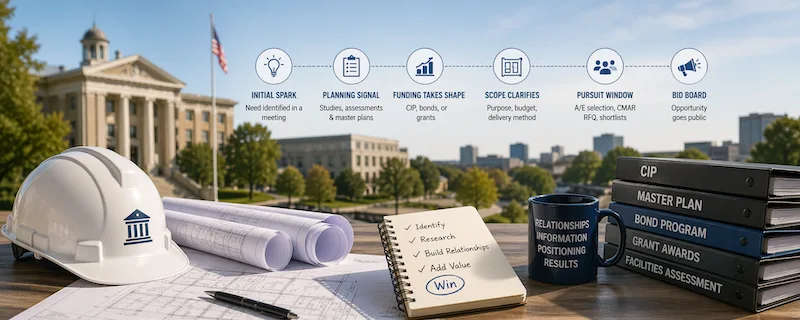
A public construction project moves through a long, visible arc. Most of the arc is invisible to firms that only watch bid boards.
- Initial spark. A board, council, or commission discusses a need — a failing roof, an aging boiler, a track that's past its lifecycle. Usually in a facilities-committee meeting.
- Planning signal. The owner commissions a facilities condition assessment, a master plan, or a feasibility study. A consultant is engaged. A document appears.
- Funding takes shape. The project lands in a CIP, a bond program, or a grant application. The line item is budgeted.
- Scope clarifies. The owner defines purpose, site, delivery method (CMAR, design-bid-build, design-build), and a likely construction window.
- Pursuit window. A/E selection happens. Sometimes a CMAR RFQ. Shortlists form. This is the sweet spot — the project is real, the players are known, and the procurement is not public yet.
- Bid board. The opportunity posts. It's now everyone's problem.
If your only signal is the last step, you're playing a different game than the firms that win.
Where to look
Public owners publish most of what you need to know. The problem isn't access — it's volume and dispersion. A single territory can cover 40 school districts, 80 municipalities, two dozen park districts, a handful of counties, and several authorities. Each has its own meeting cadence, document repository, and planning cycle.
The richest public-owner sources:
- Board meeting agendas and minutes. Where projects are first discussed and where consultants are approved.
- Capital Improvement Plans (CIPs). Usually a rolling 5-year document with line items, dollar amounts, and target years.
- Facilities master plans. Long-horizon plans that name specific buildings, scopes, and rough budgets.
- Bond campaigns and referendum ballots. Bond language is often specific enough to identify individual projects.
- Grant awards. LWCF, RTP, FEMA BRIC, EPA 319, DOE Renew America's Schools — these precede bids by 12–24 months.
- Facilities condition assessments, energy audits, ADA transition plans. Each one is a multi-project backlog that will eventually convert into bids.
What to do with a signal
Finding a signal is table stakes. The value is in what you do with it.
- Confirm stage. Is this a mention in a minutes document, a budgeted CIP line, or an A/E selection? Your action is different for each.
- Map stakeholders. Facilities director, superintendent or city manager, finance director, and — once the consultant is engaged — the engineer or architect. Get names, roles, contact info.
- Pick the next move. Attend the next facilities committee meeting. Send a capabilities statement to the facilities director. Schedule a lunch with the engineer. Do not send a generic email.
- Track the cycle. Public projects move on public calendars. Board meetings, budget cycles, bond votes. Your follow-up should ride the calendar.
What not to do
Three common traps sink early-pursuit efforts:
- Don't pitch on the first contact. At stage 2 or 3, the owner doesn't know what they want yet. Offer to be useful — share case studies, offer a lunch-and-learn, volunteer to help the engineer scope the study. Your pitch comes later.
- Don't skip the consultant. Roofing consultants, MEP engineers, civil engineers, and architects write the specs. If you don't know them, you're not in the running regardless of the owner relationship.
- Don't mistake the bid board for pipeline. Bid-board listings are commodities. Your pipeline is the list of projects you know about before they post.
The punchline
Winning government construction work isn't about being faster at the bid board. It's about having already built the relationships, known the scope, and positioned the specification before the bid is a bid. The information you need is public. The hard part is seeing it in time to matter.