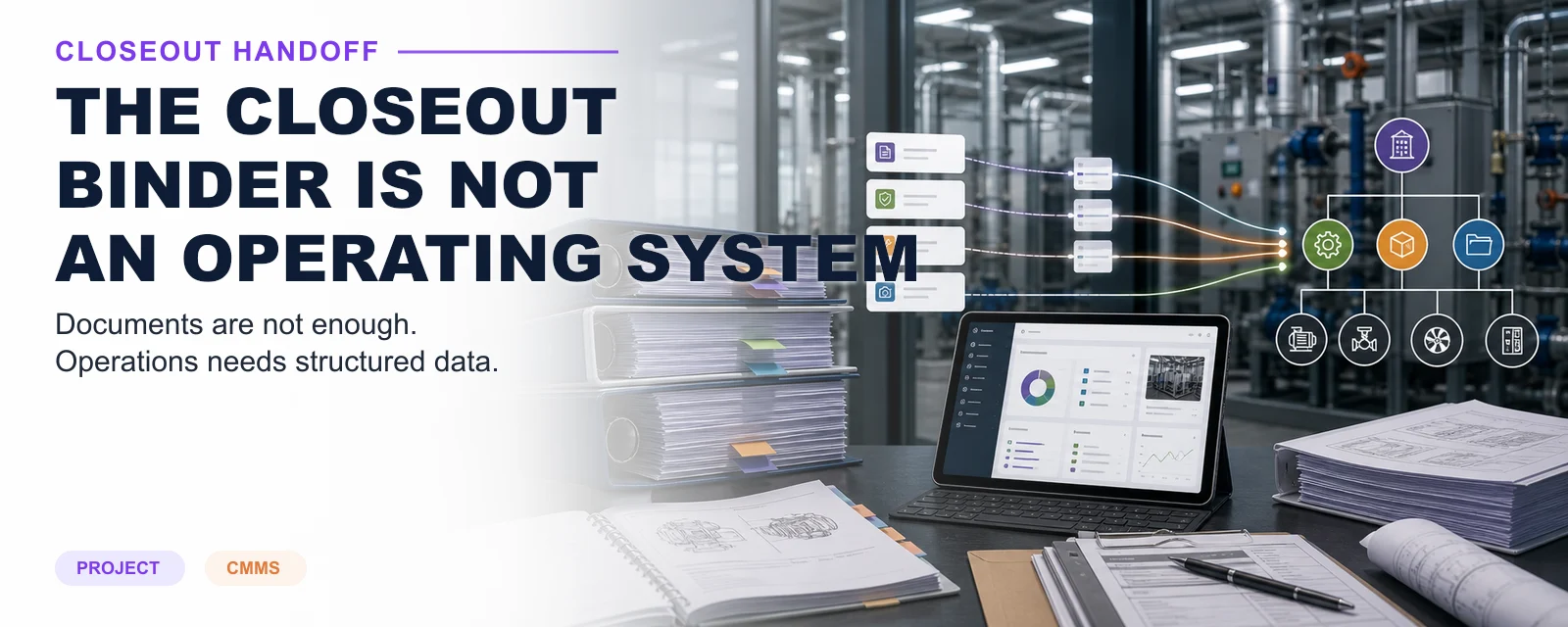
A closeout binder can be complete and still fail the owner.
That sounds unfair until you watch what happens after turnover. The project team delivers folders, PDFs, O&M manuals, warranty letters, training records, test reports, attic stock lists, and as-built documents. The owner receives the package. Everyone checks the box. Then facilities spends the next several months translating that package into work the building can actually use.
The binder was delivered. The operating system was not.
The difference between documents and operating data
Documents are necessary. Nobody is arguing against O&M manuals, warranty certificates, commissioning reports, or final drawings.
The problem is that documents are not structured operating records.
An O&M manual might contain the model number, maintenance interval, lubricant type, filter size, startup checklist, and troubleshooting table for an air handling unit. But if those facts stay buried in a PDF, the CMMS cannot schedule the PM, the inventory system cannot stock the filter, the technician cannot see the warranty terms in the field, and the reliability team cannot compare that asset to its peers.
The data exists. It just did not make the handoff.
This is not a new idea. COBie exists because building handover has always needed a structured way to move spaces, equipment, product data, O&M information, and commissioning context into operations. Closeout specifications often ask for record documents, O&M data, warranties, inspection certificates, and training evidence for the same reason. The industry already knows the owner needs more than a pile of files.
The gap is that most projects still treat those requirements as document collection instead of operating-system creation.
Why owners feel this later
The cost of weak closeout is delayed.
It shows up when a warranty claim is missed because the asset record does not know the warranty period. It shows up when a technician searches for a manual while standing in a mechanical room. It shows up when the first PM is guessed from a generic template. It shows up when a replacement part is ordered wrong because the approved submittal and installed equipment do not match.
Most of those failures are not dramatic. They are quiet friction.
The building starts operating with avoidable uncertainty.
What closeout should create
A useful closeout process should create more than an archive.
It should create:
- Asset records with manufacturer, model, serial, location, install date, and warranty terms.
- PM seeds based on approved equipment and owner standards.
- O&M manuals attached to the asset, not just stored in a folder.
- Commissioning exceptions connected to the installed system.
- Training records tied to the people and equipment involved.
- Spare parts and attic stock records that can become inventory.
- Final acceptance evidence that finance, project management, and facilities can all trust.
This does not mean every closeout artifact must become structured data. It means reliability-critical facts should not be trapped in documents.
The Sympl Project view
Sympl · Project treats closeout as the bridge between delivery and operations.
During construction, submittals and commissioning records are already creating the future asset record. At closeout, that data should materialize into a maintenance system as a draft operating asset graph. Facilities reviews and accepts it. The building starts with context instead of a blank register.
That is the difference between handing over a binder and handing over an operating system.
The binder answers, "Did we deliver the required documents?"
The operating system answers, "Can this owner maintain the building tomorrow?"