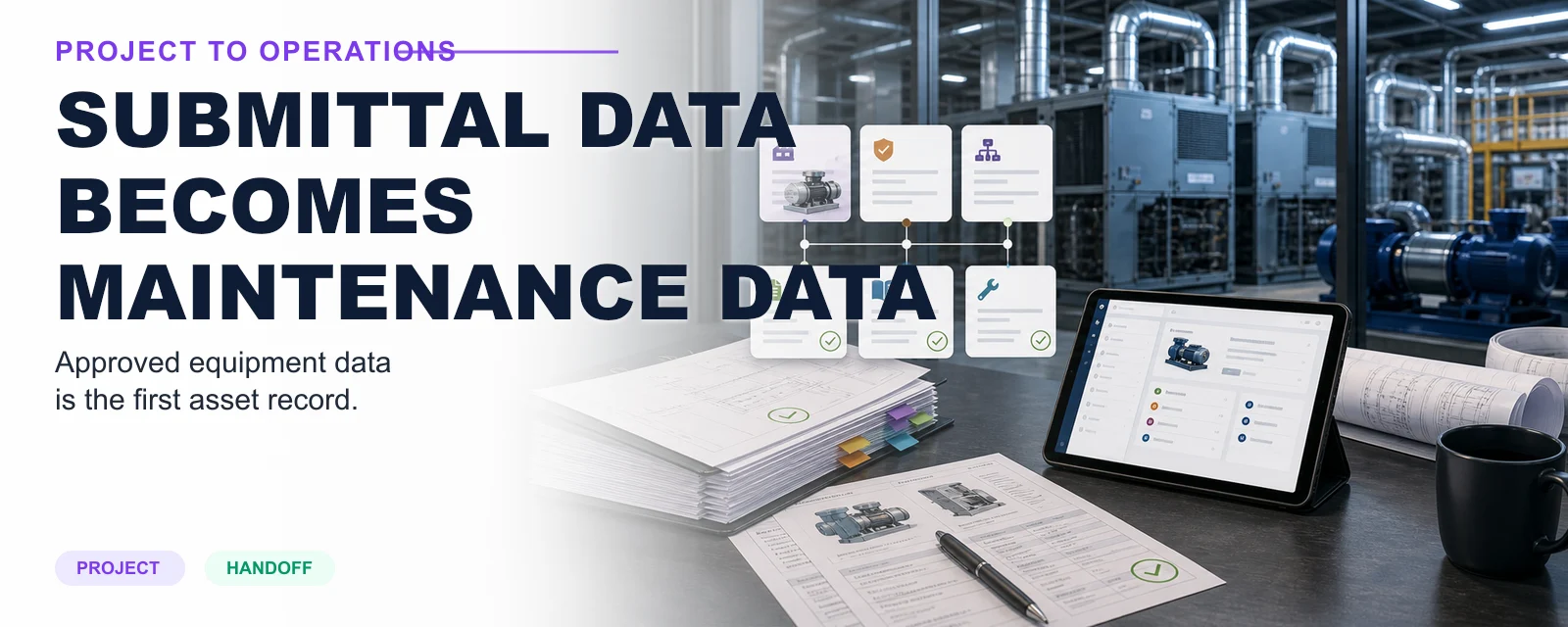
Submittals are where the future maintenance burden becomes visible.
On most projects, they are treated as approval paperwork. The contractor submits equipment data. The design team reviews it. The owner may be copied. The project moves on.
That workflow is necessary, but it misses the bigger point. For anything the owner will operate, the submittal is often the first structured version of the asset record.
The useful data is already there
A mechanical equipment submittal can contain manufacturer, model, capacity, voltage, efficiency, dimensions, replacement filters, control sequences, warranty language, startup requirements, and recommended maintenance.
An electrical submittal can contain breaker data, panel schedules, ratings, spare capacity, and manufacturer documentation.
A roofing submittal can contain assembly data, warranty terms, inspection requirements, and maintenance instructions.
None of that is just project paperwork. It is future operating context.
If the information is approved during construction, then retyped into the CMMS months later, the owner has already paid twice: once to create the data and once to reconstruct it.
This is why the line between project controls and reliability is thinner than it looks. The approved submittal is not only evidence that the design team accepted a product. It is also a maintenance input that can shape spare parts, PM intervals, warranty reminders, nameplate records, and technician instructions.
Why manual handoff breaks down
The traditional handoff depends on humans reading documents and deciding what matters.
That creates inconsistency. One facilities team may capture warranty dates but not model numbers. Another may capture manuals but miss spare parts. A third may import equipment names but flatten locations and systems.
The result is a CMMS that looks populated but cannot support reliability work.
The asset exists, but the record is thin.
What should flow forward
Not every submittal field needs to become maintenance data. The owner does not need every review comment in the CMMS. But maintainable assets should carry a core set of facts forward:
- Manufacturer, model, serial or serial range, and approved substitutions.
- Location, system, asset class, and maintainable components.
- Warranty terms and warranty contacts.
- O&M manuals and troubleshooting instructions.
- Recommended maintenance tasks and intervals.
- Spare parts, filters, lubricants, belts, and consumables.
- Commissioning and startup evidence.
- Exceptions that facilities should know before operating the asset.
That is the information technicians, planners, and reliability teams will search for later.
Where Sympl Project fits
Sympl · Project is designed so the submittal log does not die at closeout.
As project data is approved, it can become structured handoff data. When the building is accepted, that data can materialize into your operating system as draft assets, documents, warranty context, and PM seeds.
The owner still reviews the result. Automation should not silently create operating records without human approval. But the review starts from organized data instead of a 50GB package of files.
That is the wedge: submittals are not only about getting the project built. They are how the operating record begins.